



The Top 6 Best-Selling Guitar Picks from 6 Years of Rombo Picks (And Why Guitarists Love Them)
The Top 6 Best-Selling Guitar Picks from 6 Years of Rombo Picks (And Why Guitarists Love Them)
After six exciting years of designing, testing, and shipping high-quality guitar picks around the world, we’ve learned a lot about what guitarists truly value. From jazz players to metal shredders, beginners to professionals — certain picks consistently rise to the top.
In this article, we’re celebrating our top 6 best-selling guitar picks, based on real customer preferences, playing styles, and thousands of reviews. Whether you’re looking for precision, versatility, warmth, or speed, there’s something here for every guitarist.

We’ll also share how these picks evolved, how we determined their popularity, and help you figure out which one might be right for your style. If you’re curious about how shape, thickness, material, and grip influence your playing — this guide has it all.
Our Journey: 6 Years of Listening to Guitarists
Rombo Picks was born from a deep obsession with design and the belief that guitar picks deserved more innovation. Since day one, we’ve been testing materials, studying ergonomics, and gathering insights from thousands of guitarists around the world.
Over the past six years, these insights have shaped every design decision. The picks on this list aren’t just best-sellers — they’re symbols of how far we’ve come in understanding what players want in their hands.
Let’s dive into the top 6 picks, why they stand out, and what real musicians have to say about them.
1. Rombo Diamond — Precision and Power for Advanced Players
Why It’s a Bestseller
The Rombo Diamond has been our best-selling pick for years. With a sharp, focused tip and a sturdy 2.00 mm thickness, it delivers incredible precision and fast response. It’s engineered for technical players who rely on accuracy and speed, but also want power and volume.
Ideal For:
-
Fast alternate picking
-
Shredding and solos
-
Djent and technical metal (we call it the palm mute master!)

Playing Feel
The pointed shape gives a tight, precise attack. Players describe it as “gliding through strings with minimal resistance.” Despite its stiffness, it feels natural thanks to beveled edges and a textured grip.
The tone is dark, direct, percussive, and focused — ideal for cutting through a mix. Its full-body shape adds depth and enhances low-end frequencies.
Common Reviews:
-
“Best pick I’ve ever used for fast picking.”
-
“It feels like a scalpel for your tone — ultra precise.”
-
“I use it for both solos and tight rhythm parts. It’s super stable.”
Behind the Design
This pick was designed for advanced players looking for full control. Its geometry, grip pattern, and material blend make it one of our most complex, feedback-driven designs.
2. Rombo Origami — The Ultimate All-Rounder
Why It’s a Bestseller
Origami stands out for its adaptability. Inspired by folded paper structures, its ergonomic shape offers a natural grip that suits nearly every genre. With mid-range thickness and moderate flex, it balances comfort and articulation.
It also showcases our innovation in grip design: The folded surfaces prevent rotation, providing extra stability.
Ideal For:
-
Strumming and arpeggios
-
Blues leads, pop, and rock riffs
-
Players who switch styles frequently
-
Warm tones on acoustic guitar

Playing Feel
The surface texture is subtle but secure. It feels balanced — neither too thick nor too light. Whether you’re strumming chords or picking melodies, it responds with warmth and clarity. The rounded tip reduces string noise while keeping note definition.
The variable thickness (a thicker body tapering to a thinner tip) helps preserve bass tones and reduce that annoying click-clack sound on acoustic guitars.
Common Reviews:
-
“It’s the pick I reach for when I don’t know what style I’ll play.”
-
“Great for both acoustic and electric.”
-
“Super comfortable. I never drop it.”
Why It Matters
Every guitarist needs a workhorse pick, and Origami is ours. Its design isn’t extreme in any one direction — and that’s exactly why it works so well.
3. Rombo Horizon — Elegance Meets Performance
Why It’s a Bestseller
Horizon blends classic elements with modern engineering. A bit thinner than the Diamond, with a super-curved tip and elegant silhouette, it’s a favorite for players who want clean articulation without harshness.
Ideal For:
-
Funk and jazz fusion
-
Sweep picking
-
Riffs that demand clarity (metal and rock included)

Playing Feel
Horizon delivers controlled brightness. The tone is clean and expressive, with just enough edge for fast passages. Its surface geometry enhances grip, while the beveled edges allow subtle dynamic shifts.
It’s designed to feel effortless — and yes, it’s my personal favorite, and the design I’m most proud of.
Common Reviews:
-
“The clearest attack I’ve ever had.”
-
“My go-to for funk rhythm and jazzy leads.”
-
“A great compromise between flexibility and control.”
The Experience
Horizon is the kind of pick that reveals its strengths over time. Surgical, reliable, and deeply satisfying.
4. Rombo Shell — A Refined Jazz III Alternative
Why It’s a Bestseller
Small, sharp, and punchy — Rombo Shell is our tribute to the Jazz III, reimagined with better grip and more comfort. Designed for speed and control, it stays securely in your fingers, even during intense play.
Ideal For:
-
Solos
-
Funk comping
-
Fast melodic playing (metal, rock, fusion)

Playing Feel
Shell offers surgical precision in a compact size. The tip is sharp, and the grip is firm. Many describe it as an extension of the fingers — perfect for speed-focused genres.
Common Reviews:
-
“It’s like a Jazz III but better in every way.”
-
“So fast, but still feels controlled.”
-
“My favorite pick for complex jazz lines.”
Design Insight
We preserved the classic jazz-style tip but enhanced the grip and ergonomics. For fans of small picks and fast play, Shell is a game-changer.
5. Rombo Classic — Warm, Familiar, and Beginner-Friendly
Why It’s a Bestseller
Rombo Classic is our most traditional pick. With a slightly flexible 0.38 mm profile and soft texture, it’s ideal for strumming and dynamic acoustic playing.
Ideal For:
-
Acoustic guitar
-
Folk and singer-songwriter styles
-
Beginners and casual players

Playing Feel
It feels light and familiar, with a warm and rounded attack. The soft grip prevents slips without distracting from your playing experience.
Common Reviews:
-
“Reminds me of old-school picks, but better.”
-
“My students always prefer this one.”
-
“Perfect for acoustic gigs.”
Why It’s Essential
Not everyone needs an aggressive or technical pick. Classic offers an easy entry into modern pick ergonomics — without overwhelming new players.
6. Rombo Prisma — Designed for Bass and Low Tunings (But Loved by Guitarists Too)
Why It’s a Bestseller
Prisma was originally designed for bass — but it quickly became a favorite among guitarists playing heavy, low-tuned music. Its thick profile and broad tip deliver power and control.
Ideal For:
-
Bass guitar (all styles)
-
Metal and drop tunings
-
Players who want a large, pointy, powerful pick

Playing Feel
Thick, textured, and grippy, Prisma provides a confident, punchy attack. Players say it adds weight and depth to their tone and helps lock in a solid rhythm.
Common Reviews:
-
“Perfect pick for bass — finally.”
-
“I use it on baritone guitar. The control is unreal.”
-
“Heavy pick for heavy tones.”
Design Insight
We included 3D shapes and curved edges to increase mass while maintaining flexibility. Combined with a very sharp tip, Prisma produces bright tones while preserving the round warmth you'd expect from a heavier pick.
How We Determined These Top 6 Picks
This list is based on:
-
Sales data from the last six years
-
Review volume and sentiment
-
Return purchases and customer loyalty
-
Direct feedback from our community
Each pick earned its place through performance, popularity, and long-term player satisfaction.
How to Choose the Right Guitar Pick: A Complete Guide
1. Understand Your Playing Style
Fast soloist? Go firm and sharp.
Strumming chords? Try something thinner and flexible.
2. Explore Pick Thickness
-
Thin (<0.55 mm): Brighter sound, ideal for strumming
-
Medium (0.55–1 mm): Balanced tone and feel
-
Thick (1–2.5 mm): Great for precision and heavy styles

3. Pick Shape and Size
-
Small picks: Control and speed
-
Large picks: Easier grip, especially for big hands
-
Sharp tips: Precision
-
Rounded tips: Warmth

4. Material and Surface Texture
-
Hard materials (e.g., CrystalBright): Bright, snappy tone
-
Softer materials: Warm tones, smooth feel
Tone can also be greatly influenced by shape and size. For example, a pick made from soft materials can sound brighter if it is pointy and thin.
Grip texture, 3D geometries, and variable thickness help prevent slips and enhance comfort — features we’ve heavily innovated at Rombo.

5. Try Before You Decide
Most players find their ideal pick only after trying several. That’s why we offer Variety Packs — so you can explore freely.
6. Factor in Genre and Instrument
-
Metal/Prog: Thick, sharp picks
-
Jazz: Small, smooth picks
-
Acoustic: Medium or thin, rounded picks
-
Bass: Thick, textured picks
(But of course — rules are meant to be broken.)
7. Ergonomics and Comfort
Comfort isn’t cosmetic. A well-designed pick reduces fatigue, increases precision, and makes you a better player.
Still Not Sure? Try Them All.
The best way to find your ideal pick is to experiment.
🎸 Try our Rombo Variety Pack to explore every shape and material.
👉 Use our Rombo Guitar Pick Finder Tool to get personalized recommendations based on your style and preferences.

PIcture by @brandon.delgadoe
Final Thoughts
Each of these picks represents a different type of player — and a different chapter of our Rombo journey. Whether you're discovering us for the first time or have been with us from the start, we hope this guide helps you find your perfect match.
From classic silhouettes to futuristic contours, every Rombo pick is built with care, feedback, and inspiration.
Thanks for being part of our story.
— The Rombo Picks Team


The Problem With Standard Guitar Picks: Why a New Approach Matters
When you think about essential tools for guitar players, picks—small, simple, and often overlooked—rarely get the attention they deserve. Yet this tiny piece of gear has a profound impact on a guitarist’s tone, speed, dynamics, and comfort.

Since the 1960s, the world of guitar picks has been largely defined by one dimension: thickness. It was during this era, particularly through innovations popularized by Jim Dunlop, that the concept of standardizing picks based on thickness took root.
And while that was an important step at the time, focusing only on thickness ignored a much bigger picture—a picture that has only become more complex with the evolution of music itself.
How Standardization Limited Guitar Picks
Back in the 60s, popular genres like blues, folk, and early rock 'n' roll dominated the airwaves. Players needed basic, reliable tools, and a simple pick thickness classification was an easy solution.

However, when manufacturers zeroed in on thickness alone, other critical elements of guitar pick design became secondary. Important factors like:
-
Material (affecting grip and tone),
-
Tip shape (impacting precision and speed),
-
Overall size (affecting comfort, control and tone),
-
Body shape (influencing ergonomics and attack),
-
Surface texture (enhancing comfort),
...were often treated as afterthoughts.
This "one-size-fits-all" approach worked well enough—for a time. But it didn’t anticipate the explosion of new playing styles, techniques, and genres that were just around the corner.

New Music Demands New Tools
Think about the musical landscape today compared to the 1960s. In those days, there was no thrash metal, no shred guitar techniques, no punk rock anthems, no hyper-produced modern pop songs. Today’s guitarists face challenges that players 60 years ago could not have imagined.

We now have styles that demand:
-
Extreme speed and precision (like shredding or sweep picking),
-
Aggressive and rhythmic strumming (seen in punk or alternative rock),
-
Nuanced dynamic control (essential in modern pop, R&B, and fingerstyle genres),
-
Highly technical solos requiring picks that can glide effortlessly across strings.
In other words, today's players need picks designed for specific techniques, tones, and comfort needs—not just a slightly thicker or thinner version of the same old pick.
Rethinking the Guitar Pick: The Rombo Approach
At Rombo Picks, we saw this gap clearly. Founded by two passionate guitar players, Rombo is about rethinking everything you thought you knew about guitar picks.

We believe that a guitar pick is not just a piece of plastic—it's an extension of your fingers, your style, and your voice as a musician. That’s why we’ve developed 12 unique guitar pick shapes, each designed thoughtfully for different playing styles and preferences.

Some of the key innovations that set Rombo Picks apart include:
-
3D Ergonomic Design: Each pick is sculpted for natural finger placement, reducing hand fatigue during long sessions and increasing the total mass of the pick reducing treble and pick noise.
-
Micro-Nodule Grip Structure: A unique surface texture that enhances grip without being abrasive.
-
High-Mirror Polished Tips: For ultra-smooth string release, allowing for faster and more precise playing and clearer tones.
-
Variety of Materials: Including sustainable materials like our EcoBlack line or CrystalBright
-
Tailored Sizes and Thicknesses: We don’t believe in one-size-fits-all. Our picks come in a range of thicknesses, shapes, and sizes, each fine-tuned for a specific feel and response.
Whether you’re a fast lead guitarist, an aggressive rhythm player, a nuanced fingerstyle artist, or a beginner exploring different styles, there's a Rombo pick designed with your specific needs in mind.

Why Material and Shape Matter
Many guitarists don’t realize how much pick material influences tone. Softer materials can create a warmer sound, while harder materials bring out a brighter, more articulate tone.
Similarly, tip shape can completely change your playing experience:
-
Sharp tips provide incredible precision for solos and fast passages.
-
Rounded tips are perfect for smooth strumming and a softer, more mellow sound.
Size matters too—larger picks give you better control and are easier to hold, while smaller picks can offer greater agility and speed.
At Rombo, we embrace the complexity. We celebrate the idea that every player’s needs are different—and that’s something a standard medium-thick pick could never fully address.
The Future of Guitar Picks is Personal
The days of picking a "standard" guitar pick off the rack without a second thought are behind us. Guitarists today deserve more—more comfort, more precision, more choice.
At Rombo, we believe that the guitar pick of the future is not standardized—it’s personalized.
This is why we offer not just one or two shapes, but a full collection designed to match the diverse needs of modern players. With Rombo, you can find the perfect pick for shredding, strumming, sweeping, tapping, or whatever new technique you invent tomorrow.
Because when your pick feels right, your music feels right.
Find Your Perfect Pick
Ready to discover the difference a truly modern pick can make? Explore the Rombo collection today and find the pick that matches your playing style, tone, and passion.


Avoid These 5 Common Mistakes When Choosing Your Guitar Pick as a Beginner
Learning the guitar is an exciting journey filled with discovery, creativity, and a few challenges along the way. While most beginners focus heavily on the guitar itself, they often overlook one of the most important tools in their setup: the guitar pick.
Choosing the wrong pick can slow your progress, make playing less enjoyable, and even cause bad habits. At Rombo Picks, we’ve spent years studying how something as small as a guitar pick can have a huge impact on your playing experience.
Today, we’re going to help you avoid the 5 most common mistakes beginners make when choosing a guitar pick — and set you up for success from your very first strum.
1. Choosing a Pick Based Only on Color or Brand
Mistake:
It’s tempting to grab the coolest-looking pick or the one from a famous brand you recognize. But when you pick a guitar pick based only on its appearance, you ignore critical factors like thickness, material, and shape — all of which have a huge effect on how you play.
Why it matters:
A great pick should feel like an extension of your fingers. If it’s too stiff, too slippery, or poorly shaped for your style, it can hold you back — no matter how good it looks.
Pro Tip:
At Rombo Picks, we design our guitar picks with ergonomic shapes, grip textures, and specialized materials — not just beautiful colors. Choosing a pick designed for performance makes a real difference, even if you're just starting out.

2. Ignoring Pick Thickness and Flexibility
Mistake:
Many beginners grab a random pick without considering how thick or flexible it is. But pick thickness is crucial to how it behaves when it hits the strings.
Why it matters:
-
Thin picks (<0.55mm) are great for strumming but offer less control for lead playing.
-
Medium picks (0.55mm – 1.0mm) balance flexibility and control, making them a good starting point.
-
Thick picks (over 1 mm) provide precision for soloing, shredding, and technical playing.
Pro Tip:
If you’re new, try a medium-thickness pick first.
We recommend: Rombo Origami
(as we explained in detail here: LINK)

3. Using a Pick That’s Too Slippery or Uncomfortable
Mistake:
A pick that keeps slipping out of your hand or feels awkward to grip can make playing frustrating — and even cause tension in your hand and wrist.
Why it matters:
Grip and comfort are key, especially when you’re developing basic skills. A poor grip leads to inconsistent playing and fatigue.
Pro Tip:
Look for picks with a textured surface or special grip zones. At Rombo, every pick is designed with a micro-textured surface that provides natural grip, without needing adhesives.
All our picks have variable thickness for extra control, and the surfaces are designed to prevent the pick from rotating while playing (concave and convex 3D shapes).

4. Playing with the Wrong Pick Shape and Size
Mistake:
Not all picks are created equal! Beginners often think all picks are the same size and shape — but the reality is, different shapes can support different techniques.
Why it matters:
-
Large picks are easier to hold and control when you’re learning.
-
Small, sharp picks offer speed and precision but require more finger control.
Pro Tip:
If you’re just starting out, a slightly larger pick like Rombo Classic might feel more natural. As you grow, you can experiment with different shapes like sharp tips for speed or triangular picks for versatile playing.
5. Sticking with One Pick Instead of Exploring Options
Mistake:
Many beginners choose one pick and never try anything else, missing out on the incredible variety available today.
Why it matters:
Different picks can unlock different tones, dynamics, and techniques. You might discover that a heavier pick helps your picking speed, or that a softer pick improves your rhythm guitar sound.
Pro Tip:
We always recommend exploration! That’s exactly why Rombo Picks created 12 different pick designs, each with a unique combination of thickness, material, shape, and attack profile. Experimentation keeps your playing fresh and helps you develop your own sound.
🎯 Bonus Tip: Try a Variety Pack to Find Your Perfect Match!
When you're starting out, it’s hard to know exactly which guitar pick will feel right in your hand. That's why trying several styles at once is such a smart move.
The Rombo Variety Pack includes a selection of different shapes, thicknesses, and materials — allowing you to discover what suits your playing style best without guessing.
✅ Explore different grips
✅ Feel the difference between flexible and rigid picks
✅ Find the shape that boosts your confidence
Discover the joy of exploration — and let the right pick find you.

Final Thoughts: The Right Pick Makes a Huge Difference
When you’re just starting to play guitar, small improvements lead to big results. Avoiding these 5 beginner mistakes with guitar picks can save you months of frustration and accelerate your growth.
At Rombo Picks, we’re passionate about creating innovative guitar picks that support every player’s unique journey — whether you’re strumming your first chords or crafting intricate solos.
👉 Explore our collection of ergonomic, sustainable, and beautifully designed guitar picks to find the perfect match for your playing style.
Remember:
The right pick doesn’t just change your playing — it changes how you feel about playing.


5 Essential Guitar Accessories Every Beginner Should Own
Starting your journey as a guitarist can be incredibly exciting, but with the vast array of gear and accessories available, it can also be a bit overwhelming. While the guitar itself is obviously the most critical piece of equipment, there are several other accessories that are essential for beginners. These tools not only make playing easier but also enhance the overall learning experience. In this guide, we'll cover five essential guitar accessories every beginner should own.

1. Guitar Picks: The Small Tool with a Big Impact
When you're starting out, it's easy to overlook the importance of a guitar pick. However, this small tool can significantly impact your playing style, tone, and technique. Guitar picks, or plectrums, are used to strike the strings and can produce a variety of sounds depending on their shape, thickness, and material.
Why Guitar Picks Matter for Beginners
For beginners, a guitar pick can make learning easier and more enjoyable. It helps in developing precision, speed, and consistency, which are crucial skills as you progress. Using a pick also reduces the strain on your fingers, which is particularly important for those who are just starting and may not yet have developed the necessary calluses.
The Rombo Variety Pack: Why Exploration Matters
One of the most common challenges for beginners is finding the right pick. Picks come in various shapes, sizes, materials, and thicknesses, and each one can feel different in your hand and produce a unique sound. This is where our Variety Pack comes in. This pack contains 12 picks, each designed to offer a different playing experience. Whether you prefer a warm, mellow tone or a bright, crisp sound, the Rombo Variety Pack allows you to experiment and find what suits your style best.

Exploring different picks is not just about finding what feels comfortable; it’s also about understanding how subtle changes in your gear can influence your sound. For instance, thicker picks generally produce a fuller tone with more volume, while thinner picks are often preferred for strumming as they produce a lighter, more delicate sound. The Rombo Variety Pack gives you the freedom to explore these differences, which is crucial for developing your unique playing style. Link Here.
Investing in a guitar pick variety pack is an excellent decision for beginners. It not only helps you find the right pick for your style but also aids in understanding how different factors—like material, thickness, and shape—affect your tone and playability. This exploration is a critical part of your development as a guitarist and can greatly enhance your learning experience.

2. Tuner: Stay in Tune, Stay on Track
A guitar tuner is another essential accessory that every beginner should own. Playing in tune is fundamental to sounding good and progressing in your practice sessions. There are several types of tuners available, including clip-on tuners, pedal tuners, and smartphone apps.
Why a Tuner is Important
Staying in tune ensures that your practice sessions are productive and that your ear develops correctly. Beginners often struggle to identify when their guitar is out of tune, and practicing with an out-of-tune instrument can slow down your learning and even lead to poor technique. A good tuner will help you quickly and accurately tune your guitar, making sure you're always playing at your best.
Clip-On Tuners: Convenience and Accuracy
Clip-on tuners are especially useful for beginners because they are easy to use and highly portable. They attach to the headstock of your guitar and pick up vibrations directly from the instrument, making them accurate even in noisy environments. A reliable clip-on tuner can become an indispensable part of your daily practice routine, ensuring that you always sound your best.

3. Guitar Strap: Comfort and Stability
A guitar strap might seem like a simple accessory, but it’s crucial for both comfort and stability, especially when playing standing up. For beginners, a strap can help with posture, ensuring that you hold the guitar correctly, which is essential for developing good playing habits.
Why a Good Guitar Strap Matters
A well-designed guitar strap will distribute the weight of your guitar evenly across your shoulder, preventing strain and allowing you to play for longer periods without discomfort. This is particularly important for beginners who are still building up their strength and endurance.

Choosing the Right Strap
When selecting a guitar strap, look for one that is adjustable and made from durable, comfortable material. Leather straps are popular for their durability and comfort, while synthetic materials can offer similar benefits at a lower cost. The width of the strap is also important—wider straps distribute weight more evenly, which can be more comfortable during long practice sessions.
Don’t forget the Strap Blocks!
A strap block is an indispensable guitar accessory, essential for preventing your instrument from slipping and crashing to the floor. This makes strap blocks the top budget-friendly choice and a must-have for guitarists. With strap blocks, you can perform on stage with confidence, knowing your guitar is secure no matter how you move. Link Here!

4. Capo: Unlock New Possibilities
A capo is a small device that clamps down on the strings of your guitar at a specific fret, effectively changing the pitch of the open strings. This simple tool can open up a world of possibilities, especially for beginners who might not yet be comfortable playing barre chords or using alternate tunings.
Why a Capo is Essential
Using a capo allows you to play songs in different keys without having to learn new chord shapes. This can make learning new songs easier and more enjoyable, as you can focus on strumming and timing without worrying about complex finger positions. A capo is also invaluable for playing along with recordings or other musicians, as it lets you match the key of a song without needing to transpose chords.
Choosing the Right Capo
When selecting a capo, look for one that is easy to use and doesn’t put too much pressure on your strings, which can cause them to go out of tune.

5. Guitar Case or Gig Bag: Protection on the Go
Your guitar is an investment, and protecting it should be a top priority. Whether you're taking your guitar to lessons, a friend's house, or just storing it at home, a good guitar case or gig bag is essential for keeping your instrument safe from damage.
Why You Need a Guitar Case or Gig Bag
A quality case or gig bag protects your guitar from physical damage, such as bumps and scratches, as well as environmental factors like humidity and temperature changes. This is especially important for beginners who may not yet be familiar with how to properly care for their instrument. A good case or bag can also make transporting your guitar easier and more convenient.

Choosing the Right Protection
There are two main types of guitar protection: hard cases and gig bags. Hard cases offer the best protection but can be bulky and expensive. Gig bags, on the other hand, are lighter and easier to carry but offer less protection. For beginners, a padded gig bag is often the best choice, as it provides a good balance of protection, portability, and cost.
Bonus -> 6: Multieffects pedal.
A multi-effects pedal is an essential tool for beginner guitarists looking to explore a wide range of sounds without breaking the bank. These versatile devices combine multiple effects—such as distortion, delay, reverb, and modulation—into a single, compact unit. This not only saves money but also reduces the clutter of individual pedals, making it easier for beginners to manage their gear.
One of the biggest advantages of a multi-effects pedal for beginners is its ability to offer an extensive library of tones and effects. Instead of purchasing individual pedals for each effect, a multi-effects pedal provides access to a variety of sounds, allowing beginners to experiment and discover their unique style. This versatility is particularly beneficial for those still exploring different genres, as they can easily switch between sounds suited for rock, blues, jazz, or metal with just a few clicks.
Another key benefit is the user-friendly interface. Most multi-effects pedals are designed with beginners in mind, featuring intuitive controls and pre-set patches that make it easy to start playing right out of the box. This ease of use helps beginners focus on developing their playing skills rather than getting bogged down in technicalities.
In addition, a multi-effects pedal often comes with built-in tuners, looper functions, and amp simulations, further simplifying a beginner's setup. The built-in tuner ensures that the guitar is always in tune, while the looper function helps with practice and songwriting. Amp simulations allow beginners to experience different amp sounds without needing to purchase multiple amplifiers.
Overall, a multi-effects pedal is a cost-effective, space-saving, and user-friendly solution for beginner guitarists, providing them with all the tools they need to explore and refine their sound.
Conclusion
Starting out as a guitarist is a journey filled with learning, exploration, and a lot of fun. While your guitar is the centerpiece of this journey, the right accessories can make a significant difference in how quickly you progress and how enjoyable the experience is.
Guitar picks, in particular, are an essential accessory that deserves careful consideration. The Rombo Variety Pack (Link here) offers beginners an excellent opportunity to explore different picks, helping you find the perfect match for your playing style while also expanding your understanding of how this small tool can shape your sound.

Alongside picks, a reliable tuner, a comfortable strap, a versatile capo, and a protective case or gig bag are all essential accessories that will enhance your learning experience and ensure that you're set up for success. Investing in these accessories from the start will not only make playing easier and more enjoyable but will also help you develop good habits and a deeper understanding of your instrument.

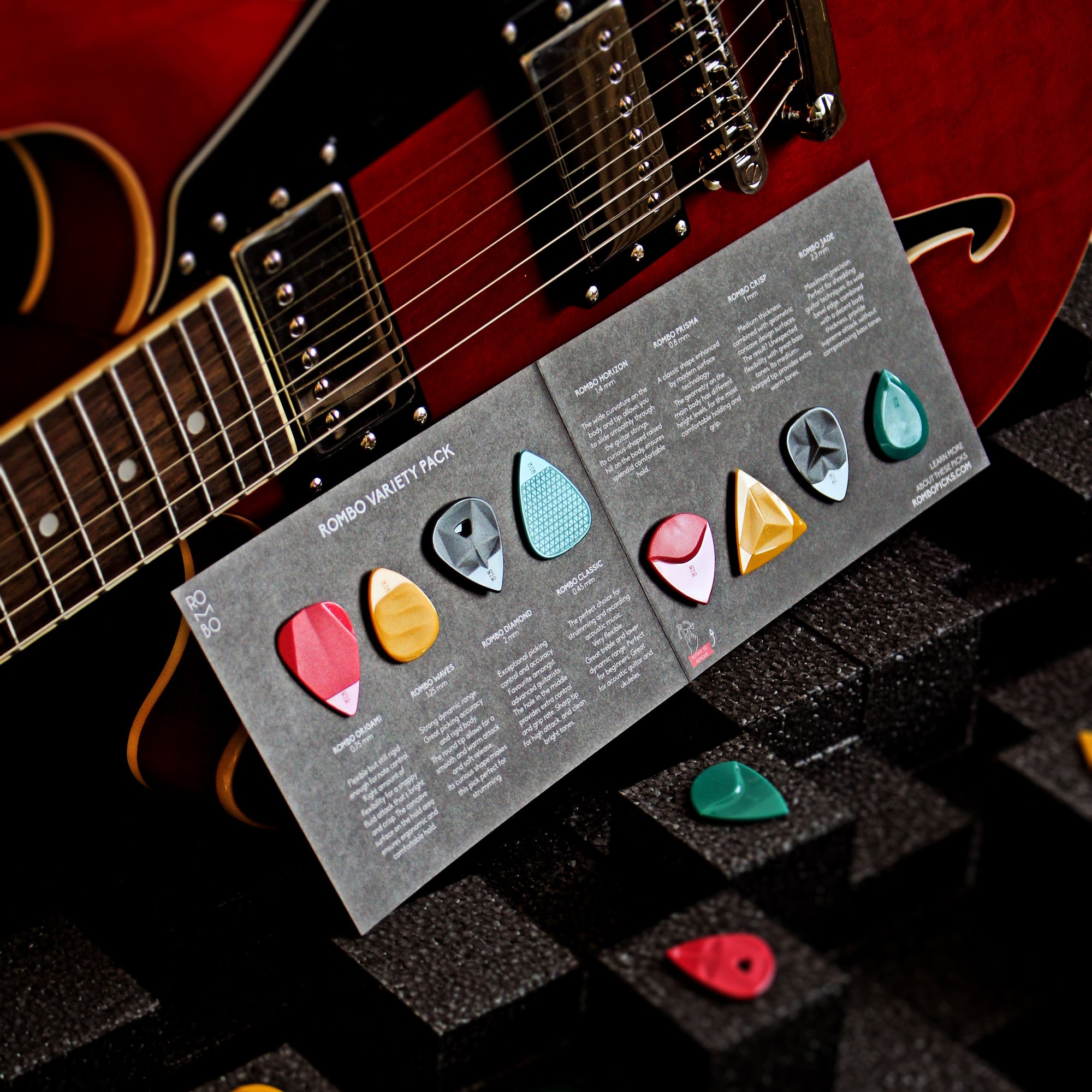
¿Por qué un paquete de variedad de púas de guitarra es una excelente opción para guitarristas principiantes y avanzados?
1- ¿Qué es un paquete de variedad de púas de guitarra?
Un paquete de variedad de púas de guitarra es un conjunto de al menos tres púas de guitarra diferentes destinadas a contener diferentes formas, tamaños, materiales o grosores de púas.
Hay otros nombres comunes para este tipo de conjunto de púas de guitarra, como "Mezcla de prueba", "Conjunto de mezcla de púas de guitarra" o "Caja de púas de guitarra". Algunos paquetes de variedad se centran en áreas específicas de la guitarra, como un "Paquete de variedad de calibre pesado", pensado para ser utilizado por jugadores avanzados o " Paquete de variedad para principiantes " que contiene púas de guitarra medianas y delgadas.

En las púas de guitarra, cualidades como el grosor, la forma, el tamaño y el material juegan un papel fundamental en el tono, el sostenido, el agarre o el ruido de la púa de la guitarra.
Por lo tanto, no se trata solo de las preferencias personales del jugador, sino también de las técnicas que desea desarrollar. Tus manos hacen un trabajo arduo, dales las herramientas adecuadas que necesitan.
2- Razones por las que un Pack Variado es una buena idea
RAZÓN UNO: es la forma más rápida y económica de cambiar el tono de tu guitarra.
Piénselo: la guitarra, las cuerdas, el amplificador, el cable y los pedales de efectos son piezas del equipo de guitarra que juegan un papel en el tono. Sorpresa: ¡también púas de guitarra!
Use una púa de nailon gruesa redondeada y obtendrá tonos más suaves, oscuros y gruesos. Use una púa de guitarra Tortex mediana puntiaguda y su tono será tan brillante como pueda imaginar.
Solo se necesitan dos segundos y el costo de un café para cambiar su selección y aumentar su espectro de tonos. Un repertorio de tonos más grande significa una mayor versatilidad.
La música se trata de mantenerse dinámico, y la monotonía mata la dinámica. Por lo tanto, tu paso más lógico como guitarrista es encontrar formas de ampliar tu repertorio de tonos y técnicas. Esto sucede con la práctica y el equipo de guitarra adecuado.

RAZÓN DOS - El placer de explorar
La teoría musical, los ejercicios de velocidad, los ejercicios de precisión y los calentamientos tienen una cosa en común: se centran en la mejora, la repetición y la perfección.
Sin embargo, el rendimiento no lo es todo y, en ocasiones, debemos centrarnos en el placer de explorar.
Las mejores ideas suceden cuando alcanzamos un estado de "flujo", también conocido como la "zona". ¡Esto también se aplica a la guitarra! Entonces, ¿por qué no relajarse por un día, probar algunas piezas nuevas, despertar un poco de creatividad tocando algunas frases de guitarra y luego ver qué sucede sin planificar demasiado y sin tener la presión de lograr un hito de desempeño específico?
Elija 4-5 selecciones diferentes, encienda el amplificador y tómese un descanso de dos horas para disfrutar de la música que está tocando ahora.
PD: ¡No olvides apagar tu teléfono!
RAZÓN TRES - Desarrollar habilidades específicas
Trate de realizar su ejercicio de velocidad con una púa de guitarra grande, desgastada y delgada. Digamos 0,35 mm.
Te enfrentarás a uno de estos tres escenarios:
- Eres más lento de lo habitual.
- Eres tan rápido como siempre pero tu técnica es mala.
- Eres más lento y tu técnica es mala.
Como en toda disciplina, utilizar las herramientas adecuadas es la clave del éxito.
Las “Guitarras Modernas” se atribuyen al músico español Antonio de Torres Jurado. Era luthier y, a mediados del siglo XIX, comenzó a crear el estilo de guitarra que se elevaría a todas las guitarras modernas.
Imagínese entonces cuán inmensa es la cantidad de técnicas de guitarra disponibles que tuvieron más de una docena de décadas para desarrollarse. Desde el rasgueo hasta el punteo híbrido, el palm mute, el punteo con barrido o el punteo hacia abajo, todas estas técnicas tienen diferentes requisitos, y los diferentes requisitos se pueden cumplir con diferentes herramientas.
En nuestro artículo, “ 7 técnicas esenciales de púa de guitarra”, hemos resumido algunas de las técnicas más comunes.
RAZÓN CUATRO - Diferentes instrumentos
Claro, el guitarrista promedio posee una Stratocaster roja con 09 cuerdas y toca rock clásico.
Pero ¿qué pasa con el resto de nosotros? ¿Los trituradores de 7 cuerdas, los fanáticos acústicos desconectados, los expertos en efectos independientes, los amantes de la música experimental, los metaleros, los bajistas que usan púas y los músicos relajados de jazz/bossa?
Todos merecemos tener una opción de acuerdo a nuestros requerimientos.

Personalmente, me gusta tocar el bajo con una púa mediana (Rombo Prisma) y me encantan los tonos cálidos de Rombo Horizon para las frases de reverberación de guitarra en mi telecaster. Sin embargo, cuando tengo ganas de usar la distorsión de metal más gruesa que haya existido, elijo Rombo Diamond.
¡Las diferentes formas, tamaños, materiales y grosores de púas de guitarra crean una tonalidad muy amplia y rangos de usabilidad que necesito para mantener mi motivación!
RAZÓN CINCO - ¡Una nueva entrada mata la rutina!
¿Usaste la misma púa de guitarra durante los últimos 20 años? Bueno, nunca es demasiado tarde para tomar un poco de aire fresco y probar algo nuevo.
Incluso el riff que ha tocado 1000 veces sonará diferente y es posible que note que hay algunos matices en la "retroalimentación de selección" que pueden hacer que su sonido sea más divertido e interesante.
Qué es lo peor que puede pasar? ¡En el peor de los casos, descubrirás una púa de guitarra que prefieres más que la habitual! Corre ese riesgo :-)
RAZÓN SEIS - Un paquete de variedad de púas de guitarra es un gran regalo
Los guitarristas tienen muchas cosas en la cabeza: el próximo concierto, la composición de una canción sin terminar que comenzaron hace algunas semanas, los índices de velocidad de su última práctica y más.

Un paquete de variedad de púas de guitarra es un gran regalo para jugadores principiantes, intermedios o avanzados. A los guitarristas les encanta probar nuevos equipos porque es una forma de despertar la creatividad y explorar tonalidades.
Un paquete de variedad es una opción súper asequible para un regalo pequeño pero elegante para hacer que un guitarrista sonría y se sienta emocionado por el próximo día de práctica.
Hay muchas opciones diferentes de regalos de Rombo:
- Paquete variado de púas de guitarra
- Caja de regalo con púa de guitarra
- Paquete variado de púas de guitarra

Si solo una de las púas de guitarra es elegida como la nueva favorita, ¡tu amigo te lo agradecerá de por vida!
RAZÓN SIETE - Reflexionando sobre el tono y el nivel de tu guitarra
Incluso si no te gustan las púas incluidas en el paquete variado, tendrán un efecto positivo en tu forma de tocar.
Reflexionarás y confirmarás por qué habías elegido tu elección actual en el pasado y cuáles son sus ventajas. Reflexionarás sobre el tono de tu guitarra y los matices de la retroalimentación y el ruido de las púas.
Estas experiencias se acumulan y, después de años de exploración, comienzas a tener un sexto sentido de "sentir" tu instrumento, tus preferencias y la música en general.
¿Qué haces con tus nuevas selecciones? Bueno, si no te gustan, ¡dáselo a un amigo que podría necesitar inspiración!
3- Quién puede beneficiarse de los paquetes variados de púas de guitarra (Spoiler: todos)
De las razones anteriores, podemos sacar una lección clara: no importa si eres un principiante o un jugador avanzado, las ventajas de probar un paquete de variedad de púas de guitarra siempre están ahí.
Por qué los principiantes se benefician de los paquetes variados de púas de guitarra:
- Desarrollar nuevas habilidades.
- Desarrolle un sentido de exploración e identifique los matices del tono.
- Comprender que diferentes técnicas necesitan diferentes requisitos.
- Entiende que el camino de la guitarra es largo y que no todo es interpretación.
Por qué los guitarristas intermedios y avanzados se benefician de los paquetes de variedad de púas de guitarra:
- Ampliar el espectro de técnicas.
- Descubre un cambio de tonalidad inesperado.
- Enfócate en una técnica específica.
- Alegría de la exploración.
4- Ejemplos de un paquete de variedad de púas de guitarra
Un ejemplo es nuestro propio paquete de variedad de púas de guitarra que contiene:
- 1 Rombo Clásico | 0,45 mm
- 1 Rombo Origami | 0,75 mm
- 1 Rombo Prisma | 0,8mm
- 1 Crisp Rombo | 1 milímetro
- 1 Olas Rombo | 1,25 mm
- 1 Rombo Horizonte | 1,4mm
- 1 Diamante Rombo | 2mm
- 1 Rombo Jade | 2,3 mm
No es sólo el grosor lo que lo es todo. Para que estas selecciones sean más comprensibles para usted, hemos creado cuatro métricas: Ataque, Flexibilidad, Tono y Técnicas. Aquí un ejemplo:

Con esta información, y en combinación con la descripción de la púa y el dibujo técnico, te damos una imagen muy precisa de las cualidades de nuestras púas de guitarra.
También disponemos de un set específico para principiantes con la “ Caja Regalo de Púas de Guitarra para Principiantes ”:
Y un set específico para jugadores intermedios/avanzados.

5. Conclusión
Un paquete variado no solo es un excelente regalo para tus amigos músicos, sino también para ti mismo si buscas explorar tonos, desarrollar habilidades específicas o simplemente necesitas aire fresco y probar nuevos equipos de guitarra.
Las diferentes cualidades como la forma, el grosor o el material hacen que las púas de guitarra sean herramientas muy diferentes para diferentes requisitos. Aprenderá mucho en el proceso de probarlos y cada aporte nuevo puede ayudarlo a mantener su motivación al más alto nivel.
En el peor de los casos: ¡Descubrirás tu nueva elección favorita!
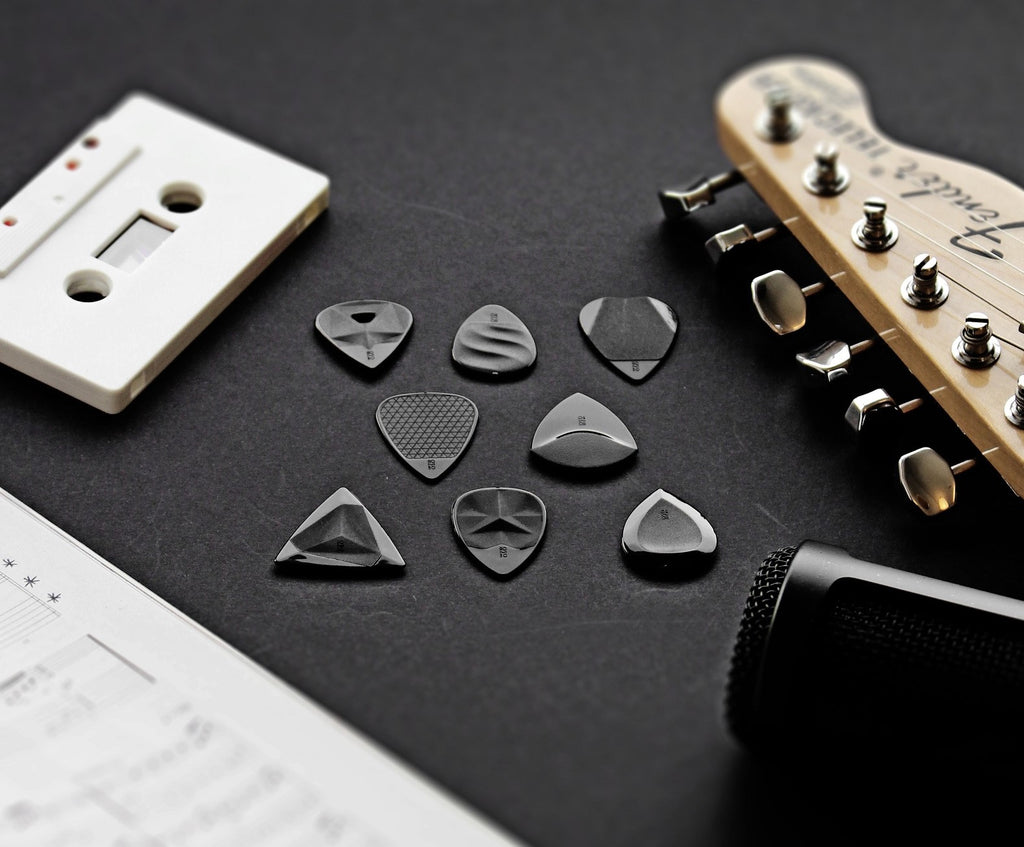


Cualidades de una púa de guitarra premium
En nuestro artículo “Cómo elegir la púa de guitarra adecuada ”, hicimos un análisis profundo sobre las cualidades que debes tener en cuenta a la hora de decidir qué púa usar.
En este artículo, discutiremos las características más importantes que se necesitan en una púa de guitarra para que la experiencia de tocar sea lo más cómoda posible y obtener los mejores resultados. Estas características no son tan evidentes como otras pero son fundamentales para sacarle el máximo partido a este accesorio .

1- ¿Qué es una púa de guitarra premium?
El Cambridge Dictionary dice que premium "se usa para referirse a algo que tiene una calidad superior a la habitual".
Por lo tanto, una púa de guitarra premium superará en cualidades como material, forma o textura y brindará una experiencia de interpretación superior al promedio en términos de precisión, durabilidad, comodidad, tono u otras áreas.
En pocas palabras, una púa de guitarra premium funcionará mejor que las púa normales.
1.1 Cómo lograr una calidad premium:
Reduciendo la definición de una púa de guitarra a sus características intrínsecas básicas, es fácil entender cómo mejorar ciertas áreas.

Por ejemplo, es lógico concluir que mejores materiales tendrán un impacto en el tono y la durabilidad de la púa de guitarra.
Además, con la ayuda de las leyes básicas de diseño y ergonomía, puede crear una forma que mejore el agarre o se deslice mejor. La clave es saber lo que estás buscando.
En 2018, con la ayuda de varios guitarristas profesionales, definimos los requisitos que debían cumplir las púas Rombo:
- Excelente tono con mínimo ruido de púa
- Durabilidad
- Comodidad y agarre
- gran aspecto _
- Versatilidad

Con estas premisas, comenzamos un viaje para identificar las cualidades que brindarían una experiencia superior a la media en cada área.

2- Cualidades de una púa de guitarra premium:
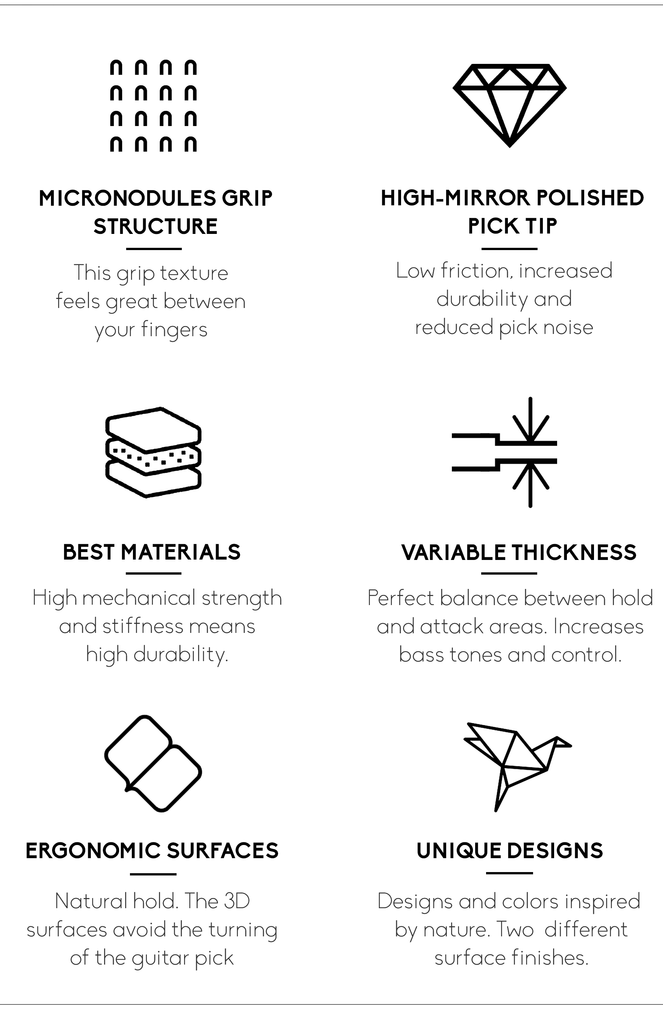
2.1 Textura de agarre de micronódulos:
Las superficies adherentes y no pegajosas son perfectas para el área de agarre de la púa de guitarra. La mejor manera de lograr esto es crear una textura que encaje entre los surcos de tu piel y evite que la púa de la guitarra se deslice o cree una geometría de agarre agresiva que sea incómoda para largas sesiones de práctica.

Al desarrollar la textura de la empuñadura, nuestro enfoque fue crear un tipo de empuñadura que permitiera al jugador mantener la flexibilidad y la libertad junto con una sensación de seguridad y control.
Puede encontrar más información sobre la empuñadura de púa de guitarra aquí .
2.2 Punta pulida de alto espejo:
Una púa de guitarra con una punta pulida le permite al jugador experimentar más control y menos fricción . La reducción de la fricción entre la púa y las cuerdas de la guitarra aumentará la durabilidad de la púa porque se desgastará menos y reducirá el ruido.
La reducción de ruido es una función especialmente útil para grabar pistas de estudio.
Además, una punta pulida produce tonos individuales más claros, un requisito para algunas técnicas de guitarra como la selección de barrido.

2.3 Espesor variable:
Una de las características menos comunes en las púas de guitarra es el grosor variable. Es ideal que la púa sea gruesa para un mejor control; sin embargo, esto podría reducir significativamente su flexibilidad.
Por eso, se han creado púas de grosor variable, brindándonos lo mejor de ambos mundos.
Es decir, podríamos tener una púa de guitarra con un cuerpo sólido y grueso que nos proporcione un mejor agarre y control . Además, cuenta con una punta más delgada que brinda suficiente flexibilidad para lograr una mayor versatilidad al desarrollar diversas técnicas de guitarra.
¡Recuerde que un aumento en el grosor de solo dos hojas de papel reducirá sustancialmente la flexibilidad de la selección!

Lea más sobre las ventajas de usar una púa de guitarra con grosor variable aquí .
2.4 Superficies de diseño ergonómico:
Siguiendo modelos ergonómicos, la superficie de la púa se puede adaptar para sentirse más cómodo y también verse bien.
Del mismo modo, podemos aprovechar las superficies cóncavas o convexas, ya que ayudan a mantener la posición de la púa orientada y evitan perder el control en los movimientos de giro.

La forma también está estrechamente relacionada con el tono de la púa de guitarra. Al igual que con el diseño de una tabla de surf, necesitas una forma específica para optimizar tu energía al atrapar una ola. El mismo efecto se produce cuando la púa de guitarra toca las cuerdas; diferentes formas producirán diferentes resultados.
2.5 Materiales de alta calidad:
Si tus manos están haciendo un trabajo arduo, entonces merecen las mejores herramientas, ¿verdad? Muchas personas gastan mucho dinero en guitarras, amplificadores, cuerdas y otros accesorios, pero pasan por alto la púa de guitarra. Este es un gran error.
El material con el que está hecha la púa puede influir en el tono, el ataque, la flexibilidad, la durabilidad y muchos otros aspectos. Por lo tanto, sin prestarle atención, difícilmente podrá encontrar su sonido personal.
¿Tienes curiosidad acerca de los materiales utilizados para las púas de guitarra Rombo? Lea un artículo completo sobre el tema aquí.

2.6 Diseños únicos:
El diseño de todo lo que posees es una forma de expresarte y definir tu estilo personal.
Cuando se trata de púas de guitarra, la funcionalidad lo es todo. Esta es la razón por la que hemos dedicado tanto tiempo a integrar hermosos patrones geométricos que también cumplen con los requisitos funcionales de cada técnica.

3- Conclusión:
En definitiva, las púas de guitarra son objetos personales que están ligados a percepciones subjetivas. Sin embargo, algunos aspectos son medibles y se pueden mejorar para cumplir con los requisitos que todo guitarrista necesita.
No sobreestimes esta pequeña pieza de equipo.
¿No estás seguro de cuál es la púa de guitarra adecuada para ti? Permítanos ayudarlo aquí .

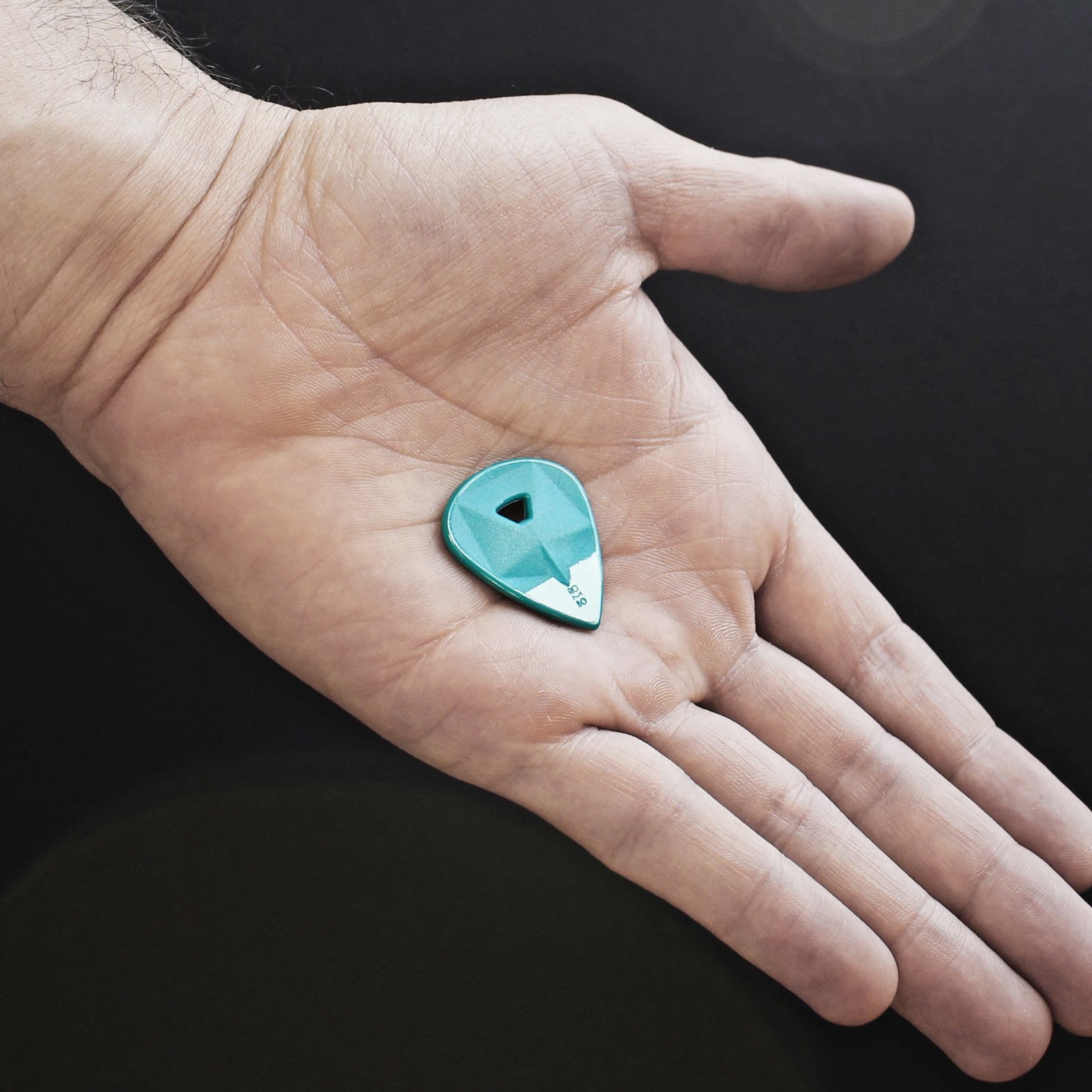
10 maneras de evitar las manos sudorosas al tocar la guitarra
Las palmas sudorosas o las manos sudorosas son uno de los problemas más comunes que sufren los guitarristas.
Tocar con las manos mojadas dificulta el juego y algunas técnicas, como las curvas y los deslizamientos, pueden ser un poco complicadas.
No solo lo hará tu forma de tocar se verá afectada por el sudor, pero también tu guitarra: las sales contenidas en el sudor erosionarán tus cuerdas e incluso pueden dañar el mástil de tu guitarra.

Si experimenta este problema con frecuencia, conocerá la sensación de agarre reducido, movimientos imprecisos y falta de control al tocar la guitarra. Esto puede llevar a momentos frustrantes y , en el peor de los casos, a dejar de tocar la guitarra para siempre.
Sin embargo, tenemos dos buenas noticias para ti:
No estás solo: las manos sudorosas es un problema que afecta a casi el 10% de los guitarristas.
Las manos sudorosas no impedirán que te conviertas en un excelente guitarrista. Hay muchas soluciones.
Hemos hecho nuestro trabajo y hemos hablado con muchos expertos para resumir las 10 formas principales de evitar las manos sudorosas al tocar la guitarra .
Consejo 1 - Relájese y cálmese:
La razón más común para sudar al tocar la guitarra es estar demasiado nervioso. Especialmente en presentaciones en vivo o durante sesiones de grabación en estudio.
En casa estás en un ambiente controlado y puedes reducir la tensión de tu cuerpo más fácilmente, puedes tomarte tu tiempo y empezar de nuevo desde el principio cuando cometas errores.

Algunos estudiantes de guitarra han informado que tienen las manos sudorosas solo durante sus lecciones o ensayos de guitarra.
Si este es tu caso, respira hondo un par de veces y calienta antes de tocar la guitarra. Trate de aprender a controlar esta situación y comprenda que es solo mental. ¡Suerte con ello!
Consejo 2 - Agua fría y jabón:
En combinación con el primer consejo, lavarse las manos con agua fría y jabón antes de tocar la guitarra puede funcionar muy bien.
El jabón elimina las células muertas de la piel y elimina los aceites y la suciedad, por lo que protegerá su guitarra de la suciedad, especialmente las cuerdas.

Consejo 3 - Juega en un lugar seco:
Incluso en los meses más cálidos, buscar un lugar seco para tocar la guitarra puede ayudar mucho cuando se trata de sudar.

Una forma de reducir la humedad del aire es mediante el uso de aire acondicionado. Otras formas alternativas de mantener una habitación seca es cultivar plantas que absorban la humedad o usar un deshumidificador.
Consejo 4: use un ventilador:
Usar un ventilador que apunte a tu guitarra te ayudará a evaporar el sudor y a mantener tus manos más frescas, haciéndolas sudar menos.
El mayor inconveniente de esta solución es el ruido creado por el ventilador. Especialmente si estás tocando en casa y quieres relajarte, el ruido de un ventilador puede resultar molesto incluso cuando tocas la guitarra eléctrica.
Consejo 5: use una toalla entre las canciones:
De la misma manera que afinas tu guitarra entre canciones, también debes secarte las manos y limpiar las cuerdas después de cada canción y después de tocar.

El sudor es un asesino de cuerdas de guitarra, y algunas personas tienen un sudor muy ácido que dañará la guitarra y las cuerdas aún más rápido.
Mantén una toalla en el estuche de tu guitarra y después de un par de sesiones ni siquiera notarás que te estás secando las manos.
Consejo 6 - Talco para bebés:
El talco para bebés, también conocido como talco , es un gran remedio casero para las manos sudorosas al tocar la guitarra. Es simple, rápido y efectivo .
Muchos grandes guitarristas han usado este método durante décadas e incluso llevaron una pequeña botella de talco para cada concierto.
Consejo 7 - Tiza de escalada:
Para tener confianza al tocar la guitarra, debe asegurarse de que sus manos sudorosas estén perfectamente cuidadas y secas.
Si el polvo de talco no funcionó, podría considerar buscar una tiza profesional para escalar.
Consejo 8 - Mantente hidratado:
Mantenerte hidratado no solo te ayudará a controlar la temperatura de tu cuerpo y te hará sudar menos, sino también a tener un sudor más saludable. ¿Qué quiero decir con esto?

Cuando su cuerpo está deshidratado, habrá un aumento en la concentración de sodio en el sudor, lo que se indica por un valor de pH más alto.
El sudor ácido es muy pegajoso e incómodo para tocar, y dañará tu guitarra y corroerá tus cuerdas aún más rápido.
Consejo 9 - Utilice el acabado adecuado para la madera del mástil de su guitarra:
Los mástiles de guitarra están hechos de diferentes tipos de madera y acabados de madera , por ejemplo, madera barnizada o desnuda .

Lleva tu guitarra a un luthier y habla sobre el problema con tus manos. Te recomendará el mejor acabado para tu tipo de piel y estilo de juego y aumentarás las posibilidades de encontrar una solución práctica.
Consejo 10 - Visite al dermatólogo:
Las manos de todos sudan. Si has probado muchos métodos para reducir el sudor mientras tocas la guitarra y esto te quita el disfrute o afecta tu técnica, debes visitar a un dermatólogo y comprobar si sufres de hiperhidrosis, una condición médica que afecta al 2,8% de la población mundial.
Trabajan todos los días con esos problemas y sabrán qué hacer para que puedas volver a tocar la guitarra sin preocupaciones.
Bonificación: Consejo 11: si te suda la mano para tocar, encuentra una púa de guitarra adecuada
A veces, el mejor lugar para comenzar es con un paquete variado que contiene diferentes púas de guitarra.

Últimos pensamientos:
Usted no está solo. Habla con otros guitarristas, comparte tus soluciones con ellos y ayúdense unos a otros. El camino de aprendizaje del guitarrista es un camino lleno de obstáculos y las manos sudorosas es solo uno de ellos.
Habla con tu profesor de guitarra y cuéntale tu problema. Probablemente, también habremos tenido otros estudiantes con el mismo problema.
Háganos saber si ha encontrado un método aún mejor para evitar que le suden las manos al tocar la guitarra , para que podamos incluirlo en este artículo. ¡Gracias!

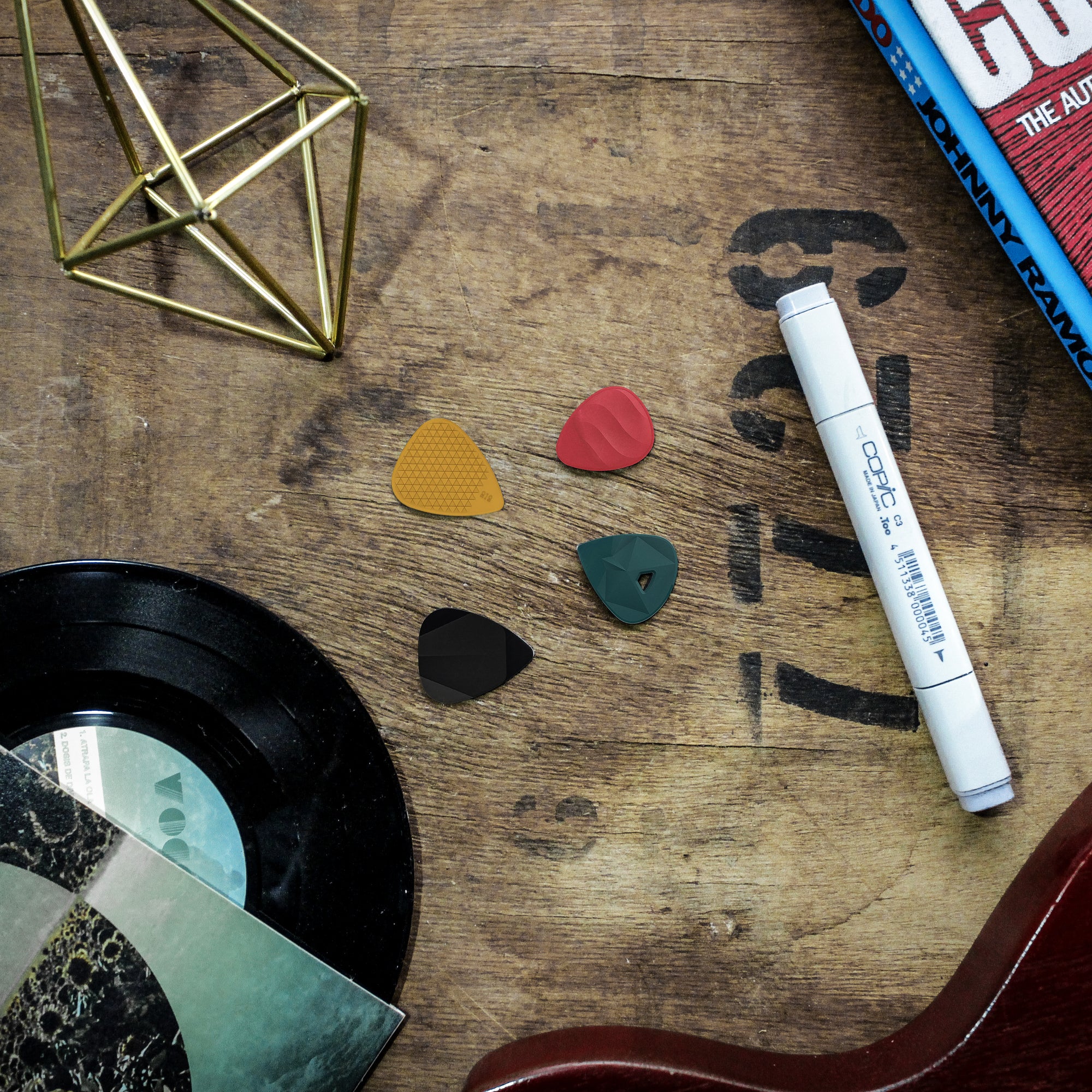
Cómo elegir la púa de guitarra adecuada en 4 pasos
¿Qué son las púas de guitarra?
Las púas de guitarra son el puente entre tú y tu instrumento. Un héroe escondido en manos de los guitarristas.
Una púa de guitarra es un artículo muy personal y elegir la mejor depende de varios factores. No existe tal cosa como una púa mágica, pero cada persona se sentirá cómoda con un estilo de púa de guitarra que le guste y disfrute.
Para elegir la púa adecuada, debe comprender algunos conceptos muy básicos.

¿Cuánta diferencia puede hacer realmente una púa de guitarra?
La púa de guitarra no solo afecta el tono y la técnica, sino también otros aspectos como el ataque (la forma en que la púa golpea las cuerdas) y la ergonomía (el control que proporciona durante las transiciones entre cuerdas).
Comprender algunas reglas básicas es esencial a la hora de elegir la púa de guitarra adecuada:
CÓMO ELEGIR LA PUNTA DE GUITARRA ADECUADA
1- Forma de la púa
La forma de la selección es un factor que los jugadores suelen pasar por alto. La mayoría de las personas tenderán a nunca alejarse de la forma estándar que todos conocemos y amamos. La forma del pincho de la guitarra afectará lo fácil que es sostenerlo y lo preciso que serás capaz de tocar.
Los tonos brillantes se logran con una punta puntiaguda, los tonos cálidos y menos definidos se producen con púas de guitarra con punta redondeada (como se ve en la figura a continuación).

Punta adicional: además, un borde biselado en la punta con bordes redondeados puede ayudar a promover una fricción más suave de la cuerda, lo que resulta en golpes y velocidad más eficientes.
2- Grosor de la púa de guitarra
El grosor de tu púa es la parte más importante de cuán brillante o cálida suena tu guitarra. Como con todo, las diferentes opciones para el grosor de las púas de guitarra tienen sus propias ventajas y desventajas.
El grosor de una púa también tiene la mayor influencia en la flexibilidad (como se ve en la figura a continuación).

El grosor de las púas de guitarra generalmente se mide en milímetros (mm) y los rangos varían mucho según la marca y el estilo musical:
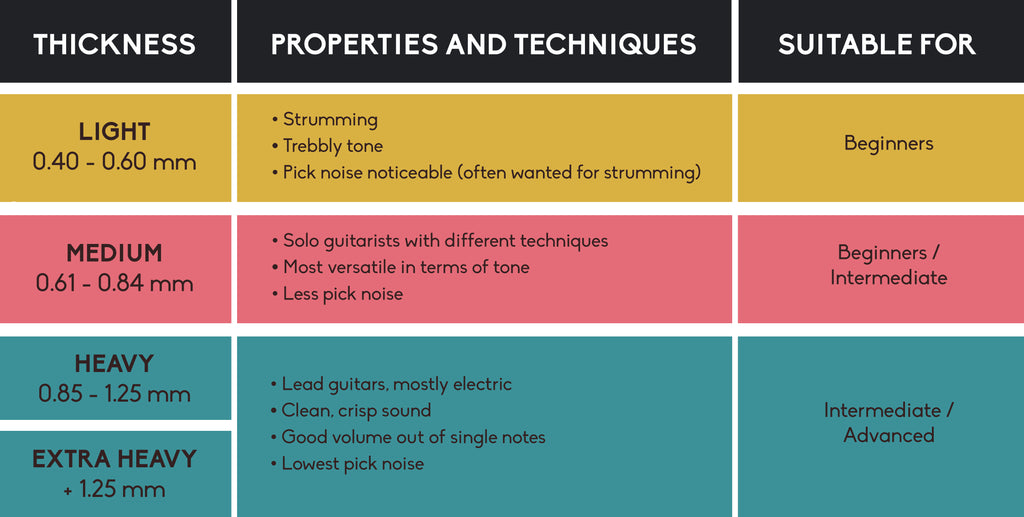
Púas de guitarra delgadas:
Bueno para la guitarra rítmica, pero no excelente para la guitarra solista debido a la falta de control al tocar notas sueltas. Se pliega fácilmente cuando está en contacto con las cuerdas y es ideal para principiantes. Siempre proporciona un sonido que parece fluido (incluso si tu brazo no lo sigue).
Selecciones medianas:
Las púas de guitarra más versátiles y perfectas para guitarristas solistas que utilizan diferentes técnicas en las mismas canciones (rasgueo, solo, palm mute, etc.…). Combinan comodidad, precisión, ritmo y velocidad de juego.
Selecciones gruesas:
Las púas gruesas le dan al guitarrista más control de volumen y ataque en las cuerdas. Favorito entre los guitarristas avanzados. La gente opta por este tipo de grosor porque necesitan precisión para su juego de alto nivel y sus partes solistas. ¡Velocidad de juego garantizada!
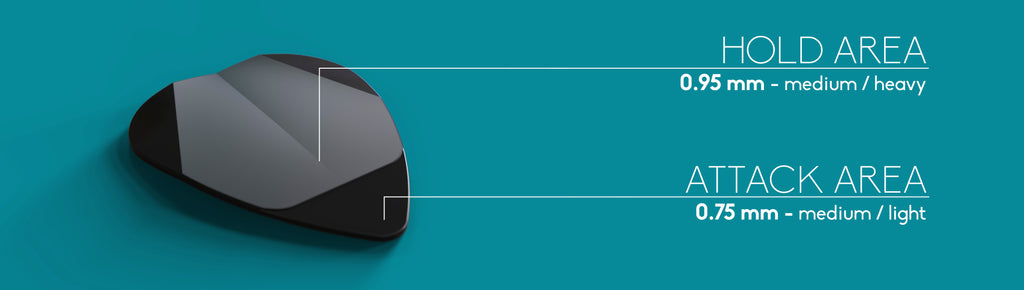
Consejo adicional: algunas púas con grosor variable (diferentes grosores en el área de agarre y el área de ataque) pueden ayudar a combinar estas características al proporcionar un cuerpo rígido y una punta más delgada y flexible.
3- El tamaño total de la púa
El tamaño del pico es el factor más importante al considerar la comodidad. Esto es extremadamente personal porque nadie es igual. Además, este punto está estrictamente relacionado con la forma de la púa de la guitarra.
Es posible que descubra que las púas pequeñas son más fáciles de triturar y crean más velocidad. Tus dedos están más cerca de las cuerdas y sientes más lo que estás tocando. La desventaja de estas púas es que se pueden dejar caer fácilmente porque son más pequeñas.
También puede encontrar que las púas más grandes son más fáciles de sostener y sentirse más cómodas. Experimente con diferentes tamaños y use lo que sea más conveniente para usted.
Por lo general, el tamaño varía entre 15 y 40 mm (como se ve en la figura a continuación).

Algunos guitarristas prefieren las púas de guitarra grandes porque al aumentar las superficies de contacto obtienen un mejor agarre.
4- Materiales y texturas de las púas
Las púas de guitarra realmente se pueden hacer de cualquier cosa. En el pasado, se usaban algunos materiales exóticos para producir púas de guitarra.
La ola tecnológica que vino con los polímeros altamente especializados creó una nueva era de materiales con propiedades sorprendentes. Por lo general, estas son las principales propiedades que debe tener un buen material:
- Alta resistencia mecánica y rigidez.
- Excelente resistencia al impacto
- Propiedades estéticas superiores
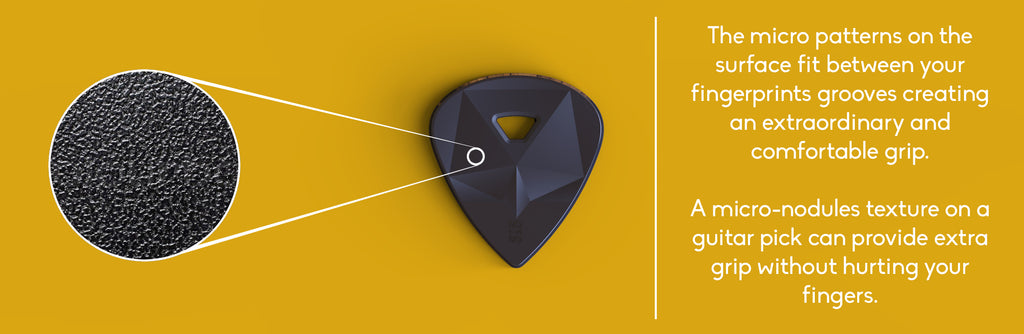
Consejo adicional: las texturas de agarre también dependen del material. Una textura de micronódulos en una púa de guitarra puede proporcionar un agarre extra sin lastimarte los dedos. Lea más en nuestro artículo "¿Por qué las texturas en las superficies de las púas de guitarra pueden ayudar a mejorar su experiencia de tocar?"
Conclusión:
La única forma de encontrar realmente tu púa de guitarra es pasar un tiempo probando nuevas formas, materiales y tamaños. A veces, tus necesidades como guitarrista cambian con el tiempo. La elección que eligió al principio de su carrera puede no ser la que necesita en este momento.
Desarrollar sus habilidades también significa adaptarse a nuevos entornos. Está comprobado que tocar con nuevas guitarras y nuevas púas de guitarra puede ayudarlo a desarrollar sus habilidades generales y mantiene su cerebro flexible, empujándolo para que sea un aprendiz continuo. No tengas miedo a la variedad.
PD: ¿Has pensado en utilizar materiales reciclados? Obtenga más información en nuestro artículo: "Rombo presenta nuevos modelos de púas de guitarra "Eco-Black Range""
