



The Problem With Standard Guitar Picks: Why a New Approach Matters
When you think about essential tools for guitar players, picks—small, simple, and often overlooked—rarely get the attention they deserve. Yet this tiny piece of gear has a profound impact on a guitarist’s tone, speed, dynamics, and comfort.

Since the 1960s, the world of guitar picks has been largely defined by one dimension: thickness. It was during this era, particularly through innovations popularized by Jim Dunlop, that the concept of standardizing picks based on thickness took root.
And while that was an important step at the time, focusing only on thickness ignored a much bigger picture—a picture that has only become more complex with the evolution of music itself.
How Standardization Limited Guitar Picks
Back in the 60s, popular genres like blues, folk, and early rock 'n' roll dominated the airwaves. Players needed basic, reliable tools, and a simple pick thickness classification was an easy solution.

However, when manufacturers zeroed in on thickness alone, other critical elements of guitar pick design became secondary. Important factors like:
-
Material (affecting grip and tone),
-
Tip shape (impacting precision and speed),
-
Overall size (affecting comfort, control and tone),
-
Body shape (influencing ergonomics and attack),
-
Surface texture (enhancing comfort),
...were often treated as afterthoughts.
This "one-size-fits-all" approach worked well enough—for a time. But it didn’t anticipate the explosion of new playing styles, techniques, and genres that were just around the corner.

New Music Demands New Tools
Think about the musical landscape today compared to the 1960s. In those days, there was no thrash metal, no shred guitar techniques, no punk rock anthems, no hyper-produced modern pop songs. Today’s guitarists face challenges that players 60 years ago could not have imagined.

We now have styles that demand:
-
Extreme speed and precision (like shredding or sweep picking),
-
Aggressive and rhythmic strumming (seen in punk or alternative rock),
-
Nuanced dynamic control (essential in modern pop, R&B, and fingerstyle genres),
-
Highly technical solos requiring picks that can glide effortlessly across strings.
In other words, today's players need picks designed for specific techniques, tones, and comfort needs—not just a slightly thicker or thinner version of the same old pick.
Rethinking the Guitar Pick: The Rombo Approach
At Rombo Picks, we saw this gap clearly. Founded by two passionate guitar players, Rombo is about rethinking everything you thought you knew about guitar picks.

We believe that a guitar pick is not just a piece of plastic—it's an extension of your fingers, your style, and your voice as a musician. That’s why we’ve developed 12 unique guitar pick shapes, each designed thoughtfully for different playing styles and preferences.

Some of the key innovations that set Rombo Picks apart include:
-
3D Ergonomic Design: Each pick is sculpted for natural finger placement, reducing hand fatigue during long sessions and increasing the total mass of the pick reducing treble and pick noise.
-
Micro-Nodule Grip Structure: A unique surface texture that enhances grip without being abrasive.
-
High-Mirror Polished Tips: For ultra-smooth string release, allowing for faster and more precise playing and clearer tones.
-
Variety of Materials: Including sustainable materials like our EcoBlack line or CrystalBright
-
Tailored Sizes and Thicknesses: We don’t believe in one-size-fits-all. Our picks come in a range of thicknesses, shapes, and sizes, each fine-tuned for a specific feel and response.
Whether you’re a fast lead guitarist, an aggressive rhythm player, a nuanced fingerstyle artist, or a beginner exploring different styles, there's a Rombo pick designed with your specific needs in mind.

Why Material and Shape Matter
Many guitarists don’t realize how much pick material influences tone. Softer materials can create a warmer sound, while harder materials bring out a brighter, more articulate tone.
Similarly, tip shape can completely change your playing experience:
-
Sharp tips provide incredible precision for solos and fast passages.
-
Rounded tips are perfect for smooth strumming and a softer, more mellow sound.
Size matters too—larger picks give you better control and are easier to hold, while smaller picks can offer greater agility and speed.
At Rombo, we embrace the complexity. We celebrate the idea that every player’s needs are different—and that’s something a standard medium-thick pick could never fully address.
The Future of Guitar Picks is Personal
The days of picking a "standard" guitar pick off the rack without a second thought are behind us. Guitarists today deserve more—more comfort, more precision, more choice.
At Rombo, we believe that the guitar pick of the future is not standardized—it’s personalized.
This is why we offer not just one or two shapes, but a full collection designed to match the diverse needs of modern players. With Rombo, you can find the perfect pick for shredding, strumming, sweeping, tapping, or whatever new technique you invent tomorrow.
Because when your pick feels right, your music feels right.
Find Your Perfect Pick
Ready to discover the difference a truly modern pick can make? Explore the Rombo collection today and find the pick that matches your playing style, tone, and passion.


Avoid These 5 Common Mistakes When Choosing Your Guitar Pick as a Beginner
Learning the guitar is an exciting journey filled with discovery, creativity, and a few challenges along the way. While most beginners focus heavily on the guitar itself, they often overlook one of the most important tools in their setup: the guitar pick.
Choosing the wrong pick can slow your progress, make playing less enjoyable, and even cause bad habits. At Rombo Picks, we’ve spent years studying how something as small as a guitar pick can have a huge impact on your playing experience.
Today, we’re going to help you avoid the 5 most common mistakes beginners make when choosing a guitar pick — and set you up for success from your very first strum.
1. Choosing a Pick Based Only on Color or Brand
Mistake:
It’s tempting to grab the coolest-looking pick or the one from a famous brand you recognize. But when you pick a guitar pick based only on its appearance, you ignore critical factors like thickness, material, and shape — all of which have a huge effect on how you play.
Why it matters:
A great pick should feel like an extension of your fingers. If it’s too stiff, too slippery, or poorly shaped for your style, it can hold you back — no matter how good it looks.
Pro Tip:
At Rombo Picks, we design our guitar picks with ergonomic shapes, grip textures, and specialized materials — not just beautiful colors. Choosing a pick designed for performance makes a real difference, even if you're just starting out.

2. Ignoring Pick Thickness and Flexibility
Mistake:
Many beginners grab a random pick without considering how thick or flexible it is. But pick thickness is crucial to how it behaves when it hits the strings.
Why it matters:
-
Thin picks (<0.55mm) are great for strumming but offer less control for lead playing.
-
Medium picks (0.55mm – 1.0mm) balance flexibility and control, making them a good starting point.
-
Thick picks (over 1 mm) provide precision for soloing, shredding, and technical playing.
Pro Tip:
If you’re new, try a medium-thickness pick first.
We recommend: Rombo Origami
(as we explained in detail here: LINK)

3. Using a Pick That’s Too Slippery or Uncomfortable
Mistake:
A pick that keeps slipping out of your hand or feels awkward to grip can make playing frustrating — and even cause tension in your hand and wrist.
Why it matters:
Grip and comfort are key, especially when you’re developing basic skills. A poor grip leads to inconsistent playing and fatigue.
Pro Tip:
Look for picks with a textured surface or special grip zones. At Rombo, every pick is designed with a micro-textured surface that provides natural grip, without needing adhesives.
All our picks have variable thickness for extra control, and the surfaces are designed to prevent the pick from rotating while playing (concave and convex 3D shapes).

4. Playing with the Wrong Pick Shape and Size
Mistake:
Not all picks are created equal! Beginners often think all picks are the same size and shape — but the reality is, different shapes can support different techniques.
Why it matters:
-
Large picks are easier to hold and control when you’re learning.
-
Small, sharp picks offer speed and precision but require more finger control.
Pro Tip:
If you’re just starting out, a slightly larger pick like Rombo Classic might feel more natural. As you grow, you can experiment with different shapes like sharp tips for speed or triangular picks for versatile playing.
5. Sticking with One Pick Instead of Exploring Options
Mistake:
Many beginners choose one pick and never try anything else, missing out on the incredible variety available today.
Why it matters:
Different picks can unlock different tones, dynamics, and techniques. You might discover that a heavier pick helps your picking speed, or that a softer pick improves your rhythm guitar sound.
Pro Tip:
We always recommend exploration! That’s exactly why Rombo Picks created 12 different pick designs, each with a unique combination of thickness, material, shape, and attack profile. Experimentation keeps your playing fresh and helps you develop your own sound.
🎯 Bonus Tip: Try a Variety Pack to Find Your Perfect Match!
When you're starting out, it’s hard to know exactly which guitar pick will feel right in your hand. That's why trying several styles at once is such a smart move.
The Rombo Variety Pack includes a selection of different shapes, thicknesses, and materials — allowing you to discover what suits your playing style best without guessing.
✅ Explore different grips
✅ Feel the difference between flexible and rigid picks
✅ Find the shape that boosts your confidence
Discover the joy of exploration — and let the right pick find you.

Final Thoughts: The Right Pick Makes a Huge Difference
When you’re just starting to play guitar, small improvements lead to big results. Avoiding these 5 beginner mistakes with guitar picks can save you months of frustration and accelerate your growth.
At Rombo Picks, we’re passionate about creating innovative guitar picks that support every player’s unique journey — whether you’re strumming your first chords or crafting intricate solos.
👉 Explore our collection of ergonomic, sustainable, and beautifully designed guitar picks to find the perfect match for your playing style.
Remember:
The right pick doesn’t just change your playing — it changes how you feel about playing.


Enhance Your Guitar’s Brightness: How CrystalBright Guitar Picks Deliver Clearer Tones
Introducing CrystalBright Guitar Picks: Enhance Your Guitar Tone with Brighter and Clearer Sound

Unveil Brilliance: Redefining Your Guitar Tone with CrystalBright Guitar Picks
Rombo is now six years old, and in that time, we have built a loyal base of guitar enthusiasts who trust our craftsmanship. We know that about 35% of our customers would appreciate a broader selection of pick materials, especially one that offers brighter and clearer tones.
In response, we committed over 12 months to material research to find the perfect formula for an advanced guitar pick, resulting in **CrystalBright**.
Imagine a guitar pick that not only withstands the test of time but also enhances your guitar’s tone with an unmistakable brightness.

Introducing CrystalBright Material for Brighter Guitar Tones
The new CrystalBright formula significantly increases surface hardness, which gives it excellent abrasion resistance. Guitar picks crafted from CrystalBright stand out for their bright tones and incredible durability. Lightweight and robust, this material also provides excellent scratch and bend resistance, making it a game-changer for electric and acoustic guitarists alike.

*Fun Fact*: CrystalBright is so resilient that it’s commonly used in aircraft canopies, offering clear tones and aesthetic appeal ideal for any guitar practice or live session.
Why Transparency? The organization of molecules in CrystalBright allows light to pass through without diffraction, resulting in an "amorphous" structure with randomly distributed macromolecules. About 92% of light can pass through it, making it more transparent than standard glass. And don’t worry—our picks are textured in the grip area, so they stay visible, and you won’t lose them easily!

ROMBO DIAMOND IN CRYSTALBRIGHT: LINK
Standard Rombo Material vs. CrystalBright Guitar Picks
Here’s a quick breakdown of what CrystalBright offers:
- Brighter tones for enhanced clarity
- Improved attack
- Increased durability
- Less flexibility
- Enhanced grip

Guitar Picks Variety Pack in CrystalBright: LINK
The “magic” of CrystalBright comes from its reduced flexibility without increasing thickness. This characteristic makes the pick notably less flexible despite being thin, resulting in a brighter, clearer tone.

Crafted by Machines – Perfected by Hand in Germany
CrystalBright’s production process is complex, requiring special attention to detail and precision. While injection molding allows us to shape each pick, CrystalBright demands additional, hands-on adjustments. Each pick goes through a meticulous process that includes:
- Injection molding for initial shaping
- Manual removal of burrs from the edges
- Hand-polishing of the pick tip for a premium finish
- Final optical inspection to ensure quality
With these steps, we achieve a level of craftsmanship that meets boutique standards, producing premium guitar picks that maintain consistency and quality.

Rombo Horizon in CrystalBright: Link Here
Our Most Durable Guitar Picks Yet
Our standard Rombo picks are known for their high durability, but CrystalBright marks a new level of endurance. Over our last three Kickstarter campaigns, we focused on premium guitar picks, using different shapes to modify properties such as tone, ergonomics, and attack. Exploring these shapes with CrystalBright has allowed us to refine the tonal adjustments required to produce the bright tones we envisioned.

Rombo Prisma CrystalBright: Link Here
Durability was a natural outcome of this process. Since brighter tones result from harder materials, we sought out the hardest acrylic available, creating a pick that maximizes both brightness and durability.
LINK TO THE CRYSTALBRIGHT COLLECTION HERE
The Design Process of our Guitar Picks



8 Myths about guitar picks
8 Myths about guitar picks
We have been in the guitar pick industry for a couple of years now. During this time, numerous customers have sent lots of inquiries with repeated questions and myths.
We have summarized the top 8 myths that “shocked” us the most, and we explain why they don’t make any sense!

1st Myth: Guitar picks don't influence guitar tone.
In guitar picks, qualities like thickness, material, shape, and size play a pivotal role in tone, feedback, grip, guitar pick noise, sustain, etc…
Why this happens has a simple explanation: Different shapes or materials make the guitar strings vibrate in different patterns.
In our article “Do guitar picks really affect the tone of your guitar” we discuss all the aspects in detail.
2nd Myth: There is a "best" pick for everything
The guitar is one of the most popular instruments because it is versatile. This versatility is achieved by a broad range of techniques. Different techniques require different picks.
Like in every guitar aspect, there is no "better" or "worse".
If you are looking for a brighter sound, then Tortex might be your choice. Nevertheless, if your aim is to get a warmer/darker/deeper tone, other materials like Nylon could perform way better.
The same applies to guitar pick thickness, shape, size, the grip texture, etc.
I recommend having at least 3 to 5 guitar picks for different specific usages. If you do not know where to start you have three options:
- Learn about guitar picks
- A Variety Pack
- Get advice (free advice here)

3rd Myth: You don't need picks if you know how to play with your fingers
Both methods are valid and appropriate for the right musical context. Your goal as a musician is to be able to create the sounds you imagine. The method is up to you!
However, some basic techniques like tremolo picking, palm mute, pinch harmonics, or pick slides are very difficult to perform with fingers. Even more, they are also faster to learn if you use guitar picks. This point also plays a role in keeping your motivation at a high level.
If you love both picking methods you’ll end up with a broader technique repertoire and will profit from both worlds.
4th Myth: Bryan May uses a coin. Everyone should do the same.
You can make a pick out of every item, a penny, paper, old credit cards, or anything else. The important thing here is the joy of exploration. Not the specific taste of one excellent influential guitarist.
Imagine how much you’ll limit yourself if you make the wrong decisions at the beginning of your career.

5th Myth: Guitar picks don't have an influence on speed.
Some qualities like pick shape, a beveled edge, and a polished guitar pick can play an important role in your speed.
“Real” guitar shredders use thick and pointy guitar picks. Probably this combination is the best place to start if you are looking for guitar speed. But remember, the most influential factor when it comes to developing speed is the number of hours of deliberate training!

6th Myth: Once you find a pick that works for you, stick to it forever.
If every song has different requirements, why always use the same guitar pick?
Different guitar picks make a difference in your tone and your playing.
I am not saying that’s impossible to play a “master of puppets” with a 0.38 mm rounded guitar pick. It is all a matter of practice and habits. However, with the right tools, you will learn faster.
In this case, for such a song with lots of palm-mute and downpicking, I would choose a thick, pointy, durable guitar pick, like Rombo Diamond.

If later today, I’m feeling like playing bossanova-jazz phrases with my semi-hollow guitar, I’ll probably use a rounded medium pick. Preferably our of Nylon.
7th Myth: Guitar picks are expensive
This is one of the most controversial aspects related to guitar picks.
You can find arguments for both the “cheap” and the “expensive” side.
Argument: “Guitar picks are expensive”:
- It’s just a piece of plastic
- I’ll lose it very fast
Argument: “Guitar picks are actually cheap”
- If it is a good one, I can use it for over 200 hours (more on durability here)
- It’s the fastest way to change the tone of your guitar
- It’s the bridge between your hands and your instrument and it deserves more attention.
- It costs less than a cup of coffee.
Put in perspective, when you purchase a guitar pick you don’t only “buy a piece of plastic”. Behind the shape and the material development there is a lot of engineering going on.
In addition, you are supporting the infrastructure behind it (customer support, web development, logistics, production, marketing, distribution, R&D, packaging,...). Without one of these single elements, there won’t be guitar picks.
8th Myth: After five seconds on the floor, a pick disappears and goes to an unknown dimension.
This happens after only three seconds, not five.


Do Guitar Picks Really Affect the Tone Of Your Guitar?
Tone, timbre, ring, and sound, are some of the terms that are usually used to refer to the sound waves produced by your guitar and amp.

Music doesn’t understand restrictions. So, one way for you as a guitarist of expanding your repertoire of guitar sounds is by asking yourself simple questions:
- Why should I change the tone of my guitar?
- How do I change the tone of my guitar?
- And… Do guitar picks really affect the tone of my guitar? And how?
We will cover these aspects and discuss some specific examples of guitar picks and guitar techniques and tones.
WHY CHANGE THE TONE OF YOUR GUITAR?
As a guitarist, you should not only reflect on your practice and skill improvements but also look for ways of increasing the amount of totally different sounds your guitar (in your hands!) is able to produce.
Imagine the wide palette of different sounds and effects that you would need to learn 30 songs from different genres.
The advantages of mastering ways to change the sound of your guitar playing are countless:
- Your compositions will be musically richer
- You will develop your innate creativity
- It will force you to learn new techniques
- It will allow you to think out of the box
In other words, you will be a better guitar player.

HOW TO CHANGE THE TONE OF YOUR GUITAR:
Think about the “chain” of connected elements that is present when you play guitar. I like to reverse it and start from the sound source:
It starts with your guitar amp and amp settings and continues through the cable (from a specific brand and specs) and your particular effect pedals. After another couple of cables, your guitar pick-ups, circuitry, wood type, and guitar strings will play a role in the tone too. What comes after that? The guitar pick and your picking hand. Note, that also your fretting hand will have an influence on sound (string pressure).

If you replace just one element, the sound will change.
The good thing here is that this is 100% measurable by recording the guitar. So everyone at home with a mid-class microphone can start noticing the differences. Of course, then, the microphone and audio interface will play a role on tone too!
Now you know what to “adjust” to allow you to make the same guitar passages sound differently.
WHY USE GUITAR PICKS FOR CHANGING THE TONE?
Go again through the complete sound chain. From all the mentioned elements, guitar picks have three main advantages when your goal is changing the tone:
- The tone changes immediately: No necessity to plug/unplug new gear or change gear settings.
- Cheap: With a minimal investment you are able to test dozens of products.
- No necessity for knowledge in other areas (recording, effects, settings,...)

Sure, using another guitar or replacing one of your pedals will have a much higher impact on tone! Nevertheless, something as simple as using another guitar pick can create appreciable differences that you will hear and enjoy.
HOW DO GUITAR PICKS CHANGE THE TONE OF YOUR GUITAR?
Guitar picks can be reduced to 4 main qualities: Material, Thickness, Shape, and Size.
These qualities define the “personality” of the guitar picks to at least 80% and they affect how guitar strings vibrate. In consequence, the different guitar string vibration patterns are different.
Some materials like Nylon produce warmer, mellower tones. Others like Tortex, create brighter sounds.
The material can also influence grip and flexibility.
Pointy guitar picks have more attack and produce brighter tones. Rounded guitar picks are especially useful for soft release and warmer tones. In techniques like strumming, rounded picks will produce less pick noise.
Thin picks and some medium picks are very flexible. This quality can produce a very characteristic “snappy attack” that is not possible with very thick picks.
Of course, everything is interconnected: Flexibility also depends on the material and shape! Thickness affects grip and guitar pick noise too.
The larger the pick, the more “mass” it has. Picks with high mass will produce warmer, darker, and fuller tones. Small picks tend to be much less flexible and have a more aggressive attack.
As you can see, you have to consider all factors together. A Tortex pick is able to produce warm tones, it needs to have the right shape, thickness, and size. On the other hand, the same happens to Nylon picks: A very pointy medium-sized Nylon pick can produce brighter sounds than the average less pointy Tortex guitar pick.
Let’s compile three ideal examples:
IDEAL GUITAR PICK FOR THICK, FULL, AND DEFINED OVERDRIVE TONES:
An ideal guitar pick for thick, full, and dark overdrive or distortion sound could be made of Nylon. It should have a sharp tip for note control and at least 1.5 mm thickness. The larger the pick, the thicker and fuller the tone.
One specific example of this could be Jazz iii XL or Rombo Diamond. The last one uses variable thickness along its body to increase its total mass and create even fuller tones with high bass in the background.

IDEAL GUITAR PICK FOR WARM STRUMMING WITH REDUCED PICK NOISE
Strumming is especially easy to perform when the tip of the guitar pick is rounded. To achieve even warmer tones the ideal strumming pick should have enough mass. The material Nylon, in combination with a medium thickness and the already mentioned rounded tip, will help reduce the pick noise.
Depending on your preferences you can use medium thickness or heavy thickness. The last one is more difficult to master but will reduce the pick noise substantially.
Good examples of this are Rombo Origami (medium gauge) or Rombo Waves (heavy gauge)
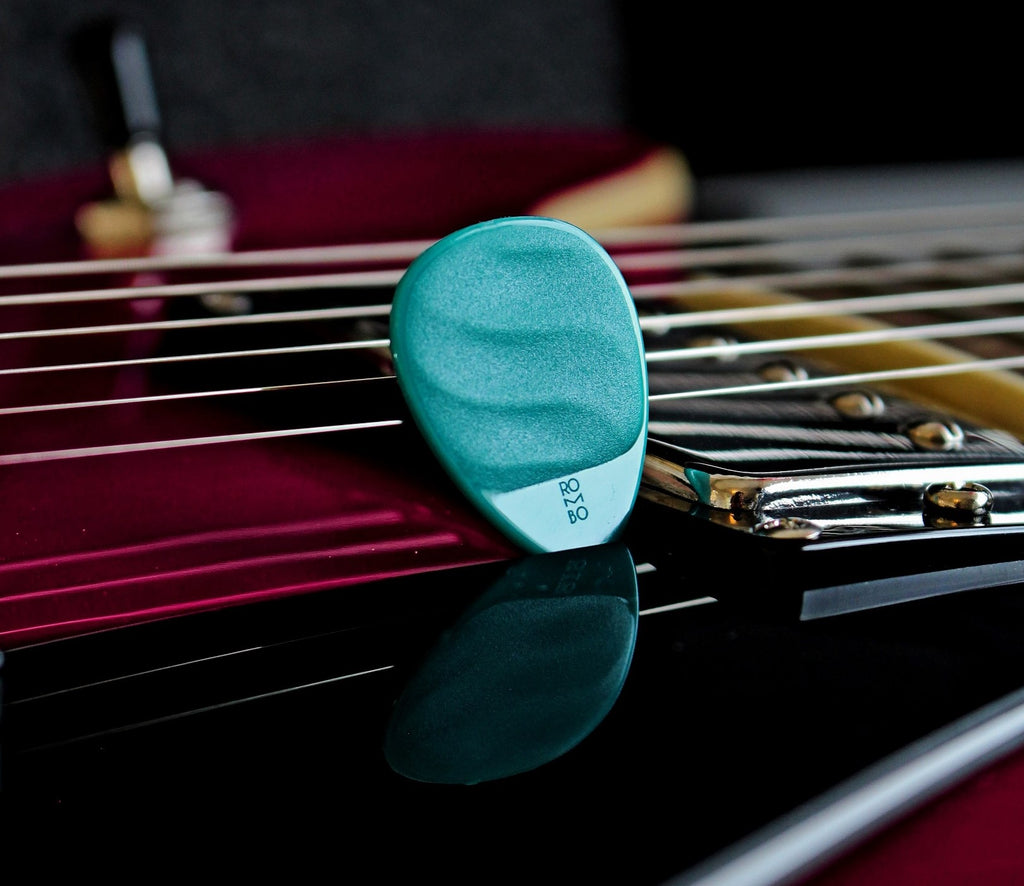
IDEAL GUITAR PICK FOR CLEAR AND DEFINED TONES
Clear and defined guitar tones are produced by pointy pick tips. Ideally, the surface of the tip is polished and has a beveled edge.
Most guitarists prefer small picks for these kinds of tones. Sweep picking, alternate picking, pinch harmonics, and other advanced lead guitar techniques are much easier to perform with such picks.
Depending on your preferences you can then choose different materials: Tortex will increase the attack and create very bright peaks, while Nylon will produce a fuller sound with more bass. Other materials (celluloid, carbon, wood,...) will behave differently.
Rombo Jade is the perfect candidate for speed, control, and attack.

CONCLUSION
Do picks change your guitar tone? Definitely yes!
Not only the tone is affected but other aspects like flexibility, grip, pick noise, attack, or control will be affected by the guitar pick too.
Sound changes will remain as a way of adding some color and dynamic to your music and guitar picks can help you here. With a very low budget and little time, you can experiment and add some fresh input to your daily guitar practice.
The most convenient way of trying many different guitar picks in just one session is by trying a variety pack containing many different guitar picks. Here you can find ours!