



How Not To Quit Guitar: Why So Many People Quit, and How to Stay Motivated
Learning to play the guitar is one of the most exciting and rewarding journeys a musician can embark on. But let’s face it—staying committed isn’t always easy. Every year, thousands of aspiring guitarists put down their instruments and never pick them back up.
Whether you're a beginner feeling overwhelmed or an intermediate player stuck in a rut, know this: you’re not alone. And more importantly, quitting is not your only option.
As someone who has spent decades immersed in guitar tone, technique, gear, and especially picks, I’ve seen firsthand what separates those who persevere from those who give up. In this article, we’ll dive deep into the real reasons players quit—and the practical strategies you can use to stay inspired.
Why So Many Guitarists Quit (and How You Can Avoid It)
Understanding the roadblocks ahead can help you avoid them. Here are the most common reasons guitarists stop playing:
1. Unrealistic Expectations
In the age of viral guitar videos and Instagram shredders, it’s easy to think you’re supposed to master finger-tapping or sweep picking in a month. But real progress takes time—and plateaus are part of the process. Expecting instant results is one of the biggest motivation killers.

2. Monotonous Practice Routines
Practicing without variation—endless scales, chords, or metronome drills—can feel like a chore. Creativity thrives when routines include exploration, improvisation, and variety.
3. Invisible Progress
Some of the most important improvements—like better timing, cleaner transitions, and stronger rhythm—are subtle and gradual. If you’re not tracking your progress, you may not even realize how far you’ve come.
4. Uninspiring Gear
The wrong guitar pick, a poorly set-up instrument, or a tone you dislike can turn every practice session into a struggle. Your gear should support your playing, not fight against it.
5. Lack of Community
Playing alone for too long can drain your enthusiasm. Music is a social language. Whether it’s online forums, local jam sessions, or a guitar Discord group, sharing the journey makes it meaningful.
The Secret Weapon: Exploration
Want to know the #1 strategy for not quitting guitar?
Keep exploring.

Exploration is the antidote to boredom. It transforms repetition into discovery and turns frustration into curiosity. In the coming years, as guitar culture continues to evolve, exploration will be key to staying inspired and connected to your instrument.
-
Try new genres. Play something completely outside your comfort zone—jazz, doom metal, flamenco, you name it.
-
Experiment with effects and gear. A new pedalboard setup or a different guitar tuning can completely reshape your sound and reignite your passion.
-
Use tools that enhance your creativity—like loopers, amp modelers, or even AI-generated backing tracks.
When you treat your guitar like a playground instead of a classroom, everything changes.

My Experience: Boredom Sparked a Brand
A few years ago, I hit a creative dead-end with my guitar playing. I was bored. My tone felt lifeless. Practicing had turned into a routine I was simply going through the motions with. I wasn’t inspired—and that scared me.
Out of that boredom came a question: What if the problem isn’t my playing… but the tools I’m using?
I started experimenting with guitar picks. Not just different gauges, but shapes, materials, grip surfaces—everything. And what I discovered blew me away. A small change—a pick that actually felt good in my hand—reignited my interest in guitar. Suddenly, my technique felt sharper. I was playing longer. Even simple chord changes felt fun again.

That was the moment Rombo Picks was born.
I didn’t start Rombo to build a business—I started it because I wanted to fall back in love with guitar. Over time, I realized other players were feeling the same way I had. They didn’t need more gear—they needed the right gear. Thoughtfully designed tools that don’t just look good but feel right.

Today, Rombo offers 12 unique pick shapes engineered for different grips, styles, and techniques. They're ergonomic, grippy, and designed to enhance tone and control. And yes—these small tweaks can genuinely make a big difference in how you play and how you feel about playing.
Sometimes, all it takes is the right pick to turn practice into play again.

6 Practical Tips to Stay Committed to Guitar Long-Term
Here are tried-and-true strategies that will help you stick with guitar through every plateau, setback, and busy season of life:
1. Set Micro Goals
Instead of trying to “get better at guitar,” set tiny, achievable goals: nail the intro to your favorite song, master one chord transition, or improvise for five minutes a day.
2. Inject Fun Into Practice
Jam over YouTube backing tracks, learn meme songs, or create your own licks. Make it fun, not just functional.
3. Join a Guitar Community
Engage with other players. Use platforms like Reddit, TikTok, or JamKazam to share your progress and get inspired by others.
4. Rotate Your Gear Regularly
Switch picks, strings, tunings, or even your practice location. Novelty is a secret weapon against burnout.
5. Record Yourself Often
Document your playing once a month. When you feel stuck, go back and listen to where you started—you’ll hear growth you didn’t notice.
6. Celebrate Small Wins
Finished a song? Learned a tricky lick? Played for 10 days straight? Celebrate it. Consistency matters more than perfection.

Remember: Guitar Is a Lifelong Adventure
The guitar isn’t a destination—it’s a lifelong relationship. Some days will feel effortless. Others will challenge your patience. But every phase of your journey teaches you something, whether it’s about music, discipline, or yourself.
If you feel discouraged, take a step back. Reflect on what brought you to the instrument in the first place. Try something new. Switch up your routine. Talk to other players. Sometimes, all it takes is a small spark—a new pick, a new sound, or a fresh perspective—to reignite the fire.
Final Thoughts: Don't Quit. Adapt.
The secret to not quitting guitar isn’t about grinding harder—it’s about evolving. Your interests, skills, and inspirations will shift over time. That’s not a problem—it’s part of the magic.
Stay curious. Keep exploring. Find tools that enhance your playing experience—not just technically, but emotionally. Your guitar journey is uniquely yours—so own it.
If you’re looking for one small change that could make a big difference, start with the thing that connects you directly to your tone: your guitar pick.
👉 Discover Rombo Guitar Picks – Thoughtfully designed for players who never stop evolving. Find the shape that fits your style and unlock a new level of comfort, tone, and control.


5 Essential Guitar Accessories Every Beginner Should Own
Starting your journey as a guitarist can be incredibly exciting, but with the vast array of gear and accessories available, it can also be a bit overwhelming. While the guitar itself is obviously the most critical piece of equipment, there are several other accessories that are essential for beginners. These tools not only make playing easier but also enhance the overall learning experience. In this guide, we'll cover five essential guitar accessories every beginner should own.

1. Guitar Picks: The Small Tool with a Big Impact
When you're starting out, it's easy to overlook the importance of a guitar pick. However, this small tool can significantly impact your playing style, tone, and technique. Guitar picks, or plectrums, are used to strike the strings and can produce a variety of sounds depending on their shape, thickness, and material.
Why Guitar Picks Matter for Beginners
For beginners, a guitar pick can make learning easier and more enjoyable. It helps in developing precision, speed, and consistency, which are crucial skills as you progress. Using a pick also reduces the strain on your fingers, which is particularly important for those who are just starting and may not yet have developed the necessary calluses.
The Rombo Variety Pack: Why Exploration Matters
One of the most common challenges for beginners is finding the right pick. Picks come in various shapes, sizes, materials, and thicknesses, and each one can feel different in your hand and produce a unique sound. This is where our Variety Pack comes in. This pack contains 12 picks, each designed to offer a different playing experience. Whether you prefer a warm, mellow tone or a bright, crisp sound, the Rombo Variety Pack allows you to experiment and find what suits your style best.

Exploring different picks is not just about finding what feels comfortable; it’s also about understanding how subtle changes in your gear can influence your sound. For instance, thicker picks generally produce a fuller tone with more volume, while thinner picks are often preferred for strumming as they produce a lighter, more delicate sound. The Rombo Variety Pack gives you the freedom to explore these differences, which is crucial for developing your unique playing style. Link Here.
Investing in a guitar pick variety pack is an excellent decision for beginners. It not only helps you find the right pick for your style but also aids in understanding how different factors—like material, thickness, and shape—affect your tone and playability. This exploration is a critical part of your development as a guitarist and can greatly enhance your learning experience.

2. Tuner: Stay in Tune, Stay on Track
A guitar tuner is another essential accessory that every beginner should own. Playing in tune is fundamental to sounding good and progressing in your practice sessions. There are several types of tuners available, including clip-on tuners, pedal tuners, and smartphone apps.
Why a Tuner is Important
Staying in tune ensures that your practice sessions are productive and that your ear develops correctly. Beginners often struggle to identify when their guitar is out of tune, and practicing with an out-of-tune instrument can slow down your learning and even lead to poor technique. A good tuner will help you quickly and accurately tune your guitar, making sure you're always playing at your best.
Clip-On Tuners: Convenience and Accuracy
Clip-on tuners are especially useful for beginners because they are easy to use and highly portable. They attach to the headstock of your guitar and pick up vibrations directly from the instrument, making them accurate even in noisy environments. A reliable clip-on tuner can become an indispensable part of your daily practice routine, ensuring that you always sound your best.

3. Guitar Strap: Comfort and Stability
A guitar strap might seem like a simple accessory, but it’s crucial for both comfort and stability, especially when playing standing up. For beginners, a strap can help with posture, ensuring that you hold the guitar correctly, which is essential for developing good playing habits.
Why a Good Guitar Strap Matters
A well-designed guitar strap will distribute the weight of your guitar evenly across your shoulder, preventing strain and allowing you to play for longer periods without discomfort. This is particularly important for beginners who are still building up their strength and endurance.

Choosing the Right Strap
When selecting a guitar strap, look for one that is adjustable and made from durable, comfortable material. Leather straps are popular for their durability and comfort, while synthetic materials can offer similar benefits at a lower cost. The width of the strap is also important—wider straps distribute weight more evenly, which can be more comfortable during long practice sessions.
Don’t forget the Strap Blocks!
A strap block is an indispensable guitar accessory, essential for preventing your instrument from slipping and crashing to the floor. This makes strap blocks the top budget-friendly choice and a must-have for guitarists. With strap blocks, you can perform on stage with confidence, knowing your guitar is secure no matter how you move. Link Here!

4. Capo: Unlock New Possibilities
A capo is a small device that clamps down on the strings of your guitar at a specific fret, effectively changing the pitch of the open strings. This simple tool can open up a world of possibilities, especially for beginners who might not yet be comfortable playing barre chords or using alternate tunings.
Why a Capo is Essential
Using a capo allows you to play songs in different keys without having to learn new chord shapes. This can make learning new songs easier and more enjoyable, as you can focus on strumming and timing without worrying about complex finger positions. A capo is also invaluable for playing along with recordings or other musicians, as it lets you match the key of a song without needing to transpose chords.
Choosing the Right Capo
When selecting a capo, look for one that is easy to use and doesn’t put too much pressure on your strings, which can cause them to go out of tune.

5. Guitar Case or Gig Bag: Protection on the Go
Your guitar is an investment, and protecting it should be a top priority. Whether you're taking your guitar to lessons, a friend's house, or just storing it at home, a good guitar case or gig bag is essential for keeping your instrument safe from damage.
Why You Need a Guitar Case or Gig Bag
A quality case or gig bag protects your guitar from physical damage, such as bumps and scratches, as well as environmental factors like humidity and temperature changes. This is especially important for beginners who may not yet be familiar with how to properly care for their instrument. A good case or bag can also make transporting your guitar easier and more convenient.

Choosing the Right Protection
There are two main types of guitar protection: hard cases and gig bags. Hard cases offer the best protection but can be bulky and expensive. Gig bags, on the other hand, are lighter and easier to carry but offer less protection. For beginners, a padded gig bag is often the best choice, as it provides a good balance of protection, portability, and cost.
Bonus -> 6: Multieffects pedal.
A multi-effects pedal is an essential tool for beginner guitarists looking to explore a wide range of sounds without breaking the bank. These versatile devices combine multiple effects—such as distortion, delay, reverb, and modulation—into a single, compact unit. This not only saves money but also reduces the clutter of individual pedals, making it easier for beginners to manage their gear.
One of the biggest advantages of a multi-effects pedal for beginners is its ability to offer an extensive library of tones and effects. Instead of purchasing individual pedals for each effect, a multi-effects pedal provides access to a variety of sounds, allowing beginners to experiment and discover their unique style. This versatility is particularly beneficial for those still exploring different genres, as they can easily switch between sounds suited for rock, blues, jazz, or metal with just a few clicks.
Another key benefit is the user-friendly interface. Most multi-effects pedals are designed with beginners in mind, featuring intuitive controls and pre-set patches that make it easy to start playing right out of the box. This ease of use helps beginners focus on developing their playing skills rather than getting bogged down in technicalities.
In addition, a multi-effects pedal often comes with built-in tuners, looper functions, and amp simulations, further simplifying a beginner's setup. The built-in tuner ensures that the guitar is always in tune, while the looper function helps with practice and songwriting. Amp simulations allow beginners to experience different amp sounds without needing to purchase multiple amplifiers.
Overall, a multi-effects pedal is a cost-effective, space-saving, and user-friendly solution for beginner guitarists, providing them with all the tools they need to explore and refine their sound.
Conclusion
Starting out as a guitarist is a journey filled with learning, exploration, and a lot of fun. While your guitar is the centerpiece of this journey, the right accessories can make a significant difference in how quickly you progress and how enjoyable the experience is.
Guitar picks, in particular, are an essential accessory that deserves careful consideration. The Rombo Variety Pack (Link here) offers beginners an excellent opportunity to explore different picks, helping you find the perfect match for your playing style while also expanding your understanding of how this small tool can shape your sound.

Alongside picks, a reliable tuner, a comfortable strap, a versatile capo, and a protective case or gig bag are all essential accessories that will enhance your learning experience and ensure that you're set up for success. Investing in these accessories from the start will not only make playing easier and more enjoyable but will also help you develop good habits and a deeper understanding of your instrument.


Do Guitar Picks Really Affect the Tone Of Your Guitar?
Tone, timbre, ring, and sound, are some of the terms that are usually used to refer to the sound waves produced by your guitar and amp.

Music doesn’t understand restrictions. So, one way for you as a guitarist of expanding your repertoire of guitar sounds is by asking yourself simple questions:
- Why should I change the tone of my guitar?
- How do I change the tone of my guitar?
- And… Do guitar picks really affect the tone of my guitar? And how?
We will cover these aspects and discuss some specific examples of guitar picks and guitar techniques and tones.
WHY CHANGE THE TONE OF YOUR GUITAR?
As a guitarist, you should not only reflect on your practice and skill improvements but also look for ways of increasing the amount of totally different sounds your guitar (in your hands!) is able to produce.
Imagine the wide palette of different sounds and effects that you would need to learn 30 songs from different genres.
The advantages of mastering ways to change the sound of your guitar playing are countless:
- Your compositions will be musically richer
- You will develop your innate creativity
- It will force you to learn new techniques
- It will allow you to think out of the box
In other words, you will be a better guitar player.

HOW TO CHANGE THE TONE OF YOUR GUITAR:
Think about the “chain” of connected elements that is present when you play guitar. I like to reverse it and start from the sound source:
It starts with your guitar amp and amp settings and continues through the cable (from a specific brand and specs) and your particular effect pedals. After another couple of cables, your guitar pick-ups, circuitry, wood type, and guitar strings will play a role in the tone too. What comes after that? The guitar pick and your picking hand. Note, that also your fretting hand will have an influence on sound (string pressure).

If you replace just one element, the sound will change.
The good thing here is that this is 100% measurable by recording the guitar. So everyone at home with a mid-class microphone can start noticing the differences. Of course, then, the microphone and audio interface will play a role on tone too!
Now you know what to “adjust” to allow you to make the same guitar passages sound differently.
WHY USE GUITAR PICKS FOR CHANGING THE TONE?
Go again through the complete sound chain. From all the mentioned elements, guitar picks have three main advantages when your goal is changing the tone:
- The tone changes immediately: No necessity to plug/unplug new gear or change gear settings.
- Cheap: With a minimal investment you are able to test dozens of products.
- No necessity for knowledge in other areas (recording, effects, settings,...)

Sure, using another guitar or replacing one of your pedals will have a much higher impact on tone! Nevertheless, something as simple as using another guitar pick can create appreciable differences that you will hear and enjoy.
HOW DO GUITAR PICKS CHANGE THE TONE OF YOUR GUITAR?
Guitar picks can be reduced to 4 main qualities: Material, Thickness, Shape, and Size.
These qualities define the “personality” of the guitar picks to at least 80% and they affect how guitar strings vibrate. In consequence, the different guitar string vibration patterns are different.
Some materials like Nylon produce warmer, mellower tones. Others like Tortex, create brighter sounds.
The material can also influence grip and flexibility.
Pointy guitar picks have more attack and produce brighter tones. Rounded guitar picks are especially useful for soft release and warmer tones. In techniques like strumming, rounded picks will produce less pick noise.
Thin picks and some medium picks are very flexible. This quality can produce a very characteristic “snappy attack” that is not possible with very thick picks.
Of course, everything is interconnected: Flexibility also depends on the material and shape! Thickness affects grip and guitar pick noise too.
The larger the pick, the more “mass” it has. Picks with high mass will produce warmer, darker, and fuller tones. Small picks tend to be much less flexible and have a more aggressive attack.
As you can see, you have to consider all factors together. A Tortex pick is able to produce warm tones, it needs to have the right shape, thickness, and size. On the other hand, the same happens to Nylon picks: A very pointy medium-sized Nylon pick can produce brighter sounds than the average less pointy Tortex guitar pick.
Let’s compile three ideal examples:
IDEAL GUITAR PICK FOR THICK, FULL, AND DEFINED OVERDRIVE TONES:
An ideal guitar pick for thick, full, and dark overdrive or distortion sound could be made of Nylon. It should have a sharp tip for note control and at least 1.5 mm thickness. The larger the pick, the thicker and fuller the tone.
One specific example of this could be Jazz iii XL or Rombo Diamond. The last one uses variable thickness along its body to increase its total mass and create even fuller tones with high bass in the background.

IDEAL GUITAR PICK FOR WARM STRUMMING WITH REDUCED PICK NOISE
Strumming is especially easy to perform when the tip of the guitar pick is rounded. To achieve even warmer tones the ideal strumming pick should have enough mass. The material Nylon, in combination with a medium thickness and the already mentioned rounded tip, will help reduce the pick noise.
Depending on your preferences you can use medium thickness or heavy thickness. The last one is more difficult to master but will reduce the pick noise substantially.
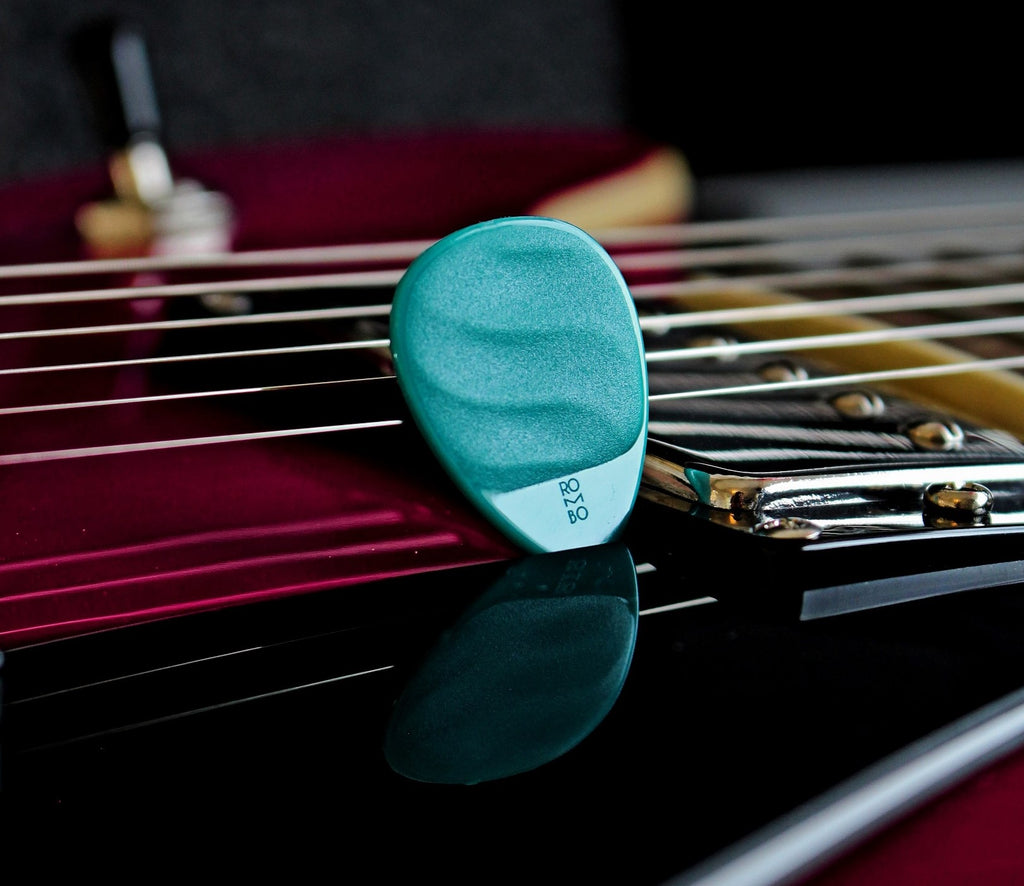
Good examples of this are Rombo Origami (medium gauge) or Rombo Waves (heavy gauge)
IDEAL GUITAR PICK FOR CLEAR AND DEFINED TONES
Clear and defined guitar tones are produced by pointy pick tips. Ideally, the surface of the tip is polished and has a beveled edge.
Most guitarists prefer small picks for these kinds of tones. Sweep picking, alternate picking, pinch harmonics, and other advanced lead guitar techniques are much easier to perform with such picks.
Depending on your preferences you can then choose different materials: Tortex will increase the attack and create very bright peaks, while Nylon will produce a fuller sound with more bass. Other materials (celluloid, carbon, wood,...) will behave differently.
Rombo Jade is the perfect candidate for speed, control, and attack.

CONCLUSION
Do picks change your guitar tone? Definitely yes!
Not only the tone is affected but other aspects like flexibility, grip, pick noise, attack, or control will be affected by the guitar pick too.
Sound changes will remain as a way of adding some color and dynamic to your music and guitar picks can help you here. With a very low budget and little time, you can experiment and add some fresh input to your daily guitar practice.
The most convenient way of trying many different guitar picks in just one session is by trying a variety pack containing many different guitar picks. Here you can find ours!

Why a guitar pick variety pack is a great choice for beginner and advanced guitar players
1- What is a Guitar Pick Variety Pack
A Guitar Pick Variety Pack is a set of at least three different guitar picks aimed to contain different shapes, sizes, materials, or thicknesses of plectrums.
There are other common names for this type of guitar pick set, like “Try out Mix,” “Guitar Pick Mix Set,” or “Guitar Pick Box.” Some variety packs are focused on specific guitar areas like a “Heavy Gauge Variety Pack,” thought to be used by advanced players or “Beginner’s Variety Pack” containing medium and thin guitar picks.

On guitar picks, qualities like thickness, shape, size, and material play a pivotal role in the guitar tone, sustain, grip, or pick noise.
Therefore, it is not only about the personal preferences of the player but also about the techniques you want to develop. Your hands do an arduous job, give them the proper tools they need.
2- Reasons why a Variety Pack is a good idea
REASON ONE - It is the fastest and cheapest way of changing your guitar tone
Think about it: The guitar, strings, amp, cable, and effects pedals are all pieces of the guitar gear that play a role in tone. Surprise: guitar picks too!
Use a rounded thick nylon pick and you’ll get mellower, darker, and thicker tones. Use a pointy medium Tortex guitar pick and your tone will be as bright as you can imagine.
It only takes two seconds and the cost of a coffee to change your pick and increase your tone spectrum. Larger tone repertoire means larger versatility.
Music is about staying dynamic, and monotony kills dynamics. Therefore, your most logical step as a guitarist is to find ways of expanding your repertoire of tones and techniques. This happens with practice and the right guitar gear.

REASON TWO - The joy of exploration
Music theory, speed exercises, precision exercises, and warm-ups all have one thing in common: They focus on improvement, repetition, and perfection.
However, performance is not everything and sometimes we should focus on the joy of exploration.
The greatest ideas happen when we achieve a “flow” state, also known as the “zone.” This applies to guitar too! So, why not relax for a day, test some new pieces of gear, spark some creativity by playing around some guitar phrases, and then see what happens without planning too much and having the pressure of achieving one specific performance milestone?
Chose 4-5 different picks, turn on the amp, and give yourself a two hours break by enjoying the music you are playing now.
PS: Don’t forget to turn off your phone!
REASON THREE - Develop specific skills
Try to perform your speed exercise with a large, worn-out, thin guitar pick. Let’s say 0.35 mm.
You will face one of these three scenarios:
- You are slower than usual.
- You are as fast as usual but your technique is bad.
- You are slower and your technique is bad.
As in every discipline, using the right tools is the key to success.
“Modern Guitars” are attributed to Spanish musician, Antonio de Torres Jurado. He was a luthier, and in the mid-1800s, he began creating the style of guitar that would rise to all modern guitars.

Imagine then how immense the number of available guitar techniques that had more than a dozen decades to be developed is. From strumming to hybrid picking, palm mute, sweep picking, or down picking, all these techniques have different requirements, and different requirements can be fulfilled with different tools.
In our article, “7 essential guitar pick techniques,” we have summarized some of the most common techniques.
REASON FOUR - Different instruments
Sure, the average guitar player owns a red Stratocaster with 09 strings and plays classic rock.
But what about the rest of us? The 7 strings shredders, the acoustic unplugged fans, the indie effect experts, the experimental music lovers, the metal-heads, the bassists using picks, and the jazz/bossa relaxed musicians out there?
We all deserve to have a choice according to our requirements.

Personally, I like to play bass with a medium pick (Rombo Prisma), and I love the warm tones of Rombo Horizon for guitar reverb phrases on my telecaster. However, when I feel like using the thickest metal distortion ever, I choose Rombo Diamond.
Different guitar pick shapes, sizes, materials, and thicknesses create a widely broad tonality and usability ranges that I need to keep my motivation up!
REASON FIVE - A fresh input kills routine!
Did you use the same guitar pick for the last 20 years? Well, it’s never too late to get a little bit of fresh air and try something new.
Even the riff you have played 1000 times will sound different and you might notice that there are some nuances on “pick feedback” that can make your sound more fun and interesting.
What is the worst that can happen? In the worst case, you will discover a guitar pick that you prefer more than your usual! Go take that risk :-)
REASON SIX - A Guitar Pick Variety Pack is a great gift
Guitar players have a lot of things going on in their heads: the next gig, one unfinished song composition they started some weeks ago, the speed rates of their last practice, and more.

A Guitar Pick Variety Pack is a great gift for beginners, intermediate, or advanced players. Guitarists love trying new gear because it is a way to spark some creativity and explore tonalities.
A variety pack is a super affordable option for a small, but elegant gift to make a guitarist smile and feel excited for the next practice day.
There are many different gift options from Rombo:

If only one of the guitar picks is chosen as the new favorite one, your friend will be thankful for life!
REASON SEVEN - Reflecting on your guitar tone and level
Even if you don’t like the picks included in the variety pack, they will have a positive effect on your playing.
You will reflect and confirm why you had chosen your current pick in the past and what the advantages of it are. You will reflect on your guitar tone and the nuances of guitar pick feedback and pick noise.
These experiences accumulate, and after years of exploration, you start having a sixth sense of “feeling” your instrument, your preferences, and music in general.
What do you do with your new picks? Well, if you don’t like them, give them to a friend that could need inspiration!
3- Who can profit from Guitar Pick Variety Packs (Spoiler: Everyone)
From the reasons above, we can take away a clear lesson: It doesn’t matter if you are a beginner or an advanced player, the advantages of trying a Guitar Pick Variety Pack are always there.
Why beginners profit from Guitar Pick Variety Packs:
- Develop new skills.
- Develop a sense of exploration and identify tone nuances.
- Understand that different techniques need different requirements.
- Understand that the guitar path is a long one and that not everything is performance.
Why intermediate and advanced players profit from guitar pick variety packs:
- Expand the spectrum of techniques.
- Discover an unexpected tonality change.
- Focus on one specific technique.
- Joy of exploration.
4- Examples of a guitar pick variety pack
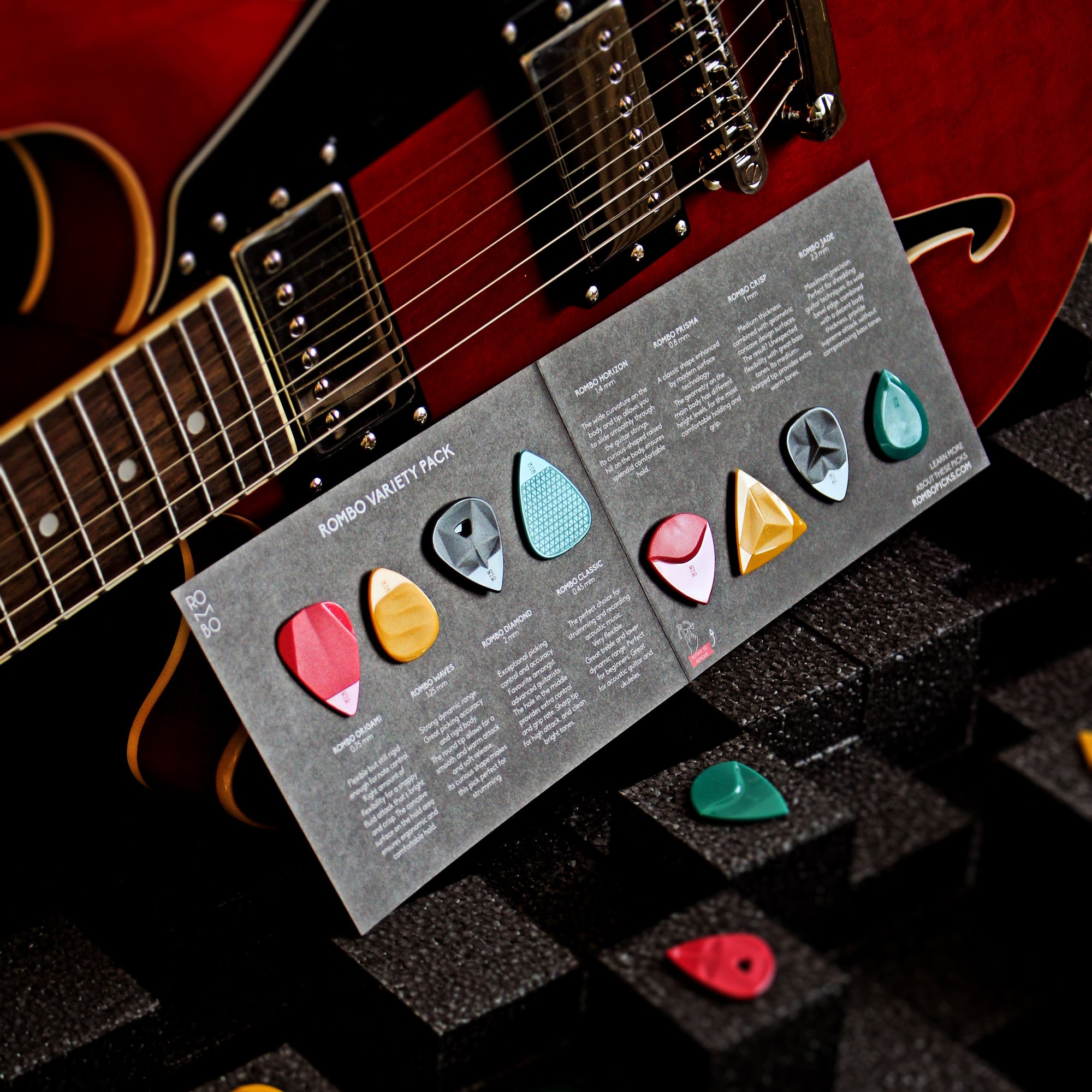
One example is our own guitar pick variety pack containing:
- 1 Rombo Classic | 0.45 mm
- 1 Rombo Origami | 0.75 mm
- 1 Rombo Prisma | 0.8 mm
- 1 Rombo Crisp | 1 mm
- 1 Rombo Waves | 1.25 mm
- 1 Rombo Horizon | 1.4 mm
- 1 Rombo Diamond | 2 mm
- 1 Rombo Jade | 2.3 mm
It is not only thickness that is everything. In order to make these picks more understandable for you, we have created four metrics: Attack, Flexibility, Tone, and Techniques. Here an example:

With this information, and in combination with the description of the pick and the technical drawing, we give you a very precise picture of the qualities of our guitar picks.
We also have a specific set for beginners with the “Beginners Guitar Pick Gift Box”:
And a specific set for intermediate/advanced players.

5- Conclusion
A Variety Pack is not only an excellent gift for your musician friends, but also for yourself if you are looking to explore tones, develop specific skills, or just need fresh air and try new guitar gear.
Different qualities like shape, thickness, or material, make guitar picks very different tools for different requirements. You will learn a lot in the process of testing them and every fresh input can help keep your motivation at the highest level.
The worst case: You will discover your new favorite pick!


Common Guitar-related Injuries and how to Avoid Pain when Playing the Guitar

Playing the guitar is fun and requires numerous hours of practice. Sometimes guitarists find themselves developing pain in different parts of the body such as their wrists, back, neck, forearm, and/or fingers.
Guitarists underestimate the dangers of injuries. According to the Bureau of Labor and Statistics, in recent surveys, nearly three-fourths of professional musicians reported past injuries and pain that affected their playing.
Every guitarist I know underestimates the risks and frequency of injuries caused by playing an instrument. As with many repetitive activities (like sports), you can prevent some injuries by understanding the root cause. Being aware of this is the only way you can commit to your guitar practice and have a worry-free (and pain-free) guitar-playing routine.
In this article, we will cover the following topics:
- Reasons for injuries caused by guitar playing
- Common guitar injuries and symptoms
- How to avoid injuries and pain when playing the guitar
Disclaimer: This article is not medical advice and is not a replacement for diagnosis or treatment by a qualified medical professional. Our goal is to advise you of some preventive methods to help you avoid injuries in the first place.
1- Reasons for injuries caused by playing the guitar
Playing the guitar, there are many sources of injuries that can be overlooked.
In most cases, the pain caused by playing the guitar starts from a combination of some of these reasons:
- Practice time
- Bad posture
- Too much pressure on the fretboard
- Bad finger technique
- Lack of a warm-up routine#
- Avoiding breaks and fatigue
- Weight of your guitar
- Prior non-guitar-related injury aggravated by playing the guitar
- Genetics (like genetic chronic back pain that can be promoted by playing the guitar)
In chapter 3, we will discuss how to prevent injuries and pain caused by guitar playing and will explain some “best practices” related to these reasons.
2- Common Guitar Injuries and Symptoms
Guitar injuries are serious because they can take guitar players out of the game permanently. There are many examples of these tragedies along with the history of music and their reason is always the same—underestimating the signals that your body sends to you.

If you are experiencing pain in some of the following areas, your body is trying to tell you that something is wrong. In that case, going to the doctor is the best option. If you want to learn how to prevent these injuries, go to chapter 3.
Most injuries can be categorized as RSI or Repetitive Strain Injury. RSIs are often long-term injuries that won't go away easily. These are directly associated with specific activities that involve repetitive movements. Guitar learning is all about repetition.
If you are experiencing pain in any of the following areas, our recommendation is to take a break for a few days and visit the doctor to ensure things aren’t more serious than they seem on the surface.
2.1- Pain in the forearm when playing the guitar:
Unlike what many guitarists think, forearm injuries are not only common for the fretting hand but also for the strumming one. If your hand position is tight, your forearm muscles are likely to tighten up too.

Putting too much pressure on the fretboard or holding the guitar pick with too much tension can develop into tendonitis.
Tendonitis is the inflammation of the tendons—the tissue that connects muscles and bones together and is involved in the function of moving your body properly.
Symptoms are pain, swelling, and motoric problems like limited hand movements. Many guitarists describe it as “the forearm feels like an old rubber band".
2.2- Pain in the hand area when playing the guitar. Wrists and fingers:
We are not talking about fingertips pulp pain known by every beginner guitar player without calluses. Those develop over time, making guitar playing comfortable at some point.
The main issue in these areas is Carpal Tunnel Syndrome that not only affects guitar players, but also any kind of activity that involves fast, precise, and repetitive finger and hand movements like pianists, hairstylists, video gamers, etc.

Again, the tendons are involved as in many movement injuries. The flexor tendons that go from the fingertips to the forearm can be easily stressed.
Symptoms are pain, weakness, or motoric problems like limited hand movements.
2.3- Pain in the elbow when playing guitar:
The famous "tennis elbow" is also a guitarist's nightmare. Technically, this is also an issue that concerns the tendons, and its correct name is "lateral epicondylitis."
The main symptoms are pain when gripping the fretboard or pain on the outside edge of the elbow.
As in most problems related to the tendons, the first symptoms are very subtle, and this can be ignored by ambitious guitar players who want to add some extra practice to their daily routines. If you are starting to feel this, the best way to prevent it is to have a rest for a couple of days and visit the doctor if the pain persists.
2.4- Pain in the back and shoulders when playing the guitar:
A lot has been said about posture, and this has a simple reason. Good posture habits can save you from experiencing lots of pain.
The problem with playing the guitar is that you need to position yourself in a bad posture to actually see what your fretting hand is doing properly. When you focus on the movements of your hands, it is very easy to forget what the rest of your body is doing, and you might slouch or sit with your back curved with no tension on it.
Back pain is dangerous because everything here is connected. So symptoms can appear on the shoulders, lower back, upper back, neck, and in other areas. This depends on many individual factors.
Fact is, this can be prevented by practicing good posture and holding the guitar closer to you as we will discuss in chapter 3.
This problem is very common among ambitious beginners that want to scale their skills fast.
A combination of three things causes the pain:
- Looking to your left for hours (or right if you are left-handed). As a beginner, you cannot practice without looking at your fretting hand.
- Fatigue of the neck muscles is caused by a lack of endurance. You are a beginner, so you did not have enough time to adapt to this new environment and movement ranges.
- Last but not least, lack of experience to estimate the reactions your skeleton and muscles might have.

3- How to avoid Injuries and Pain when playing the Guitar:
On an Instagram survey we performed with 455 participants, 64% reported having had some injuries in the past. This means almost two-thirds of the guitarists that participated have experienced some pain or lesions. You are lucky if you are amongst the 36% injury-free guitar players.

Simple actions can make a huge difference in your playing and help you avoid injuries and pain when playing the guitar:
3.1- Warm up before playing the guitar:
Playing at even semi-intense levels is stressful on the arms, hands, and the back and shoulders, just like a gym workout would be. So you need to treat it as a sport.
Warm-up can be something as easy as stretching your fingers or starting off your session by playing some techniques that aren’t as demanding as your current guitar level.

The cool thing about warming up is that once you start playing, your muscles are already prepared to deliver their best performance.
We have summarized our seven favorite warm-ups HERE.
3.2- Proper guitar technique, posture, and guitar position:
I am a big fan of self-learning. I have used self-learning techniques for foreign languages, technical skills, software, and cooking. However, in guitar, and especially in terms of avoiding injuries, I cannot repeat it enough: get a teacher.
A professional experienced teacher can help you not only develop your skills and define your learning path but also avoid and correct bad posture, too much finger tension, wrong guitar position, and other bad habits such as slouching when playing the guitar.

My recommendation if you do not have a teacher:
- Go for 2-3 private lessons that only focus on posture, technique, and guitar position
- Practice as per the advice of the teacher in front of a mirror
Sure, it will cost you some extra money, but it will prevent future problems that have a higher impact on your life than a couple of bucks.
3.3- Play guitar with less tension:
Typical tension areas are the forearms, fingers, and back.
What I did to avoid this is playing simple chords and phrases that I knew well and, while playing, concentrating on other areas of my body: is my back straight? Am I placing too much tension on the fretboard? Am I holding my guitar pick correctly? Can I avoid turning my neck and looking left?
Some hand tension can be avoided by holding the guitar pick properly. If are experiencing this, you can check our article How to hold a guitar pick.
3.4- Breaks and time management when playing the guitar:
There is a rule of thumb amongst experienced guitar players; 50 minutes practice, 10 minutes rest.
In the 10 minutes, you can check harmony and music theory, study some tabs or just stand up and move around to reduce your overall body tension.
This has two advantages:
- It prevents injuries by giving your body a break, and
- You will feel fresh after the break which results in higher quality practice results.
3.5- Do not play the guitar through pain:
If you experience some sort of pain while playing the guitar, this isn’t normal. Stop playing immediately and take a break, then evaluate whether you should go to the doctor or the physiotherapist.
3.6- Play sport:
Having good musculature in other areas of the body helps a lot when playing guitar:
- Muscles with more endurance resist more stress.
- Muscles that are used to exercise recover faster and fatigue slower.
- Regular sport lowers stress levels and diminishes accumulated tensions.
The combination of these aspects make playing sports a great alliance when it comes to guitar playing.
3.7- Use a lighter guitar for practice if you play standing up:
This is only logical: the less weight you put on your shoulders, the less stress you will have to handle. Some professional guitarists use light guitars for practice or even guitar stands and only use their performance guitars for their performances.
This is especially useful for guitar teachers that usually spend their whole days with a guitar in their hands.
3.8- Massages and ice for guitar pain relief:
If you treat guitar playing like a sport—and with sport, I mean high-stress levels caused by muscular movements in some areas of the human body—then you need a cool down.

Massaging your forearms and hands or using ice and cold water to reduce possible swelling can be a very simple additional routine to include in your daily practice. Furthermore, it is proven that such techniques reduce the recovery time, resulting in better practice results the next day.
This can also give your skin a break. If you are dealing with sweat problems when playing guitar I recommend you the article: 10 ways to avoid sweaty hands when playing guitar.
4- Conclusion:
Nearly three-fourths of professional musicians reported past injuries and pain that affected their playing.
Some of this pain disappears after a few days of rest. However, some injuries caused by guitar playing can be very harmful and in the worst case, they will kill your guitar career.
There are simple actions that can prevent you from injuries, such as warm-ups, good posture, breaks and other common-sense actions. The good thing is that these actions are simple and do not take much time. Even better, these actions increase your learning speed.
My advice: Reflect on your routine and consider every chapter of this article as a checklist for avoiding a guitar tragedy. Good luck!
PS: If you are a beginner and need help choosing the right guitar pick, please check our section Guitar Pick Finder or our Guitar Pick Variety Pack.