



The Top 6 Best-Selling Guitar Picks from 6 Years of Rombo Picks (And Why Guitarists Love Them)
The Top 6 Best-Selling Guitar Picks from 6 Years of Rombo Picks (And Why Guitarists Love Them)
After six exciting years of designing, testing, and shipping high-quality guitar picks around the world, we’ve learned a lot about what guitarists truly value. From jazz players to metal shredders, beginners to professionals — certain picks consistently rise to the top.
In this article, we’re celebrating our top 6 best-selling guitar picks, based on real customer preferences, playing styles, and thousands of reviews. Whether you’re looking for precision, versatility, warmth, or speed, there’s something here for every guitarist.

We’ll also share how these picks evolved, how we determined their popularity, and help you figure out which one might be right for your style. If you’re curious about how shape, thickness, material, and grip influence your playing — this guide has it all.
Our Journey: 6 Years of Listening to Guitarists
Rombo Picks was born from a deep obsession with design and the belief that guitar picks deserved more innovation. Since day one, we’ve been testing materials, studying ergonomics, and gathering insights from thousands of guitarists around the world.
Over the past six years, these insights have shaped every design decision. The picks on this list aren’t just best-sellers — they’re symbols of how far we’ve come in understanding what players want in their hands.
Let’s dive into the top 6 picks, why they stand out, and what real musicians have to say about them.
1. Rombo Diamond — Precision and Power for Advanced Players
Why It’s a Bestseller
The Rombo Diamond has been our best-selling pick for years. With a sharp, focused tip and a sturdy 2.00 mm thickness, it delivers incredible precision and fast response. It’s engineered for technical players who rely on accuracy and speed, but also want power and volume.
Ideal For:
-
Fast alternate picking
-
Shredding and solos
-
Djent and technical metal (we call it the palm mute master!)

Playing Feel
The pointed shape gives a tight, precise attack. Players describe it as “gliding through strings with minimal resistance.” Despite its stiffness, it feels natural thanks to beveled edges and a textured grip.
The tone is dark, direct, percussive, and focused — ideal for cutting through a mix. Its full-body shape adds depth and enhances low-end frequencies.
Common Reviews:
-
“Best pick I’ve ever used for fast picking.”
-
“It feels like a scalpel for your tone — ultra precise.”
-
“I use it for both solos and tight rhythm parts. It’s super stable.”
Behind the Design
This pick was designed for advanced players looking for full control. Its geometry, grip pattern, and material blend make it one of our most complex, feedback-driven designs.
2. Rombo Origami — The Ultimate All-Rounder
Why It’s a Bestseller
Origami stands out for its adaptability. Inspired by folded paper structures, its ergonomic shape offers a natural grip that suits nearly every genre. With mid-range thickness and moderate flex, it balances comfort and articulation.
It also showcases our innovation in grip design: The folded surfaces prevent rotation, providing extra stability.
Ideal For:
-
Strumming and arpeggios
-
Blues leads, pop, and rock riffs
-
Players who switch styles frequently
-
Warm tones on acoustic guitar

Playing Feel
The surface texture is subtle but secure. It feels balanced — neither too thick nor too light. Whether you’re strumming chords or picking melodies, it responds with warmth and clarity. The rounded tip reduces string noise while keeping note definition.
The variable thickness (a thicker body tapering to a thinner tip) helps preserve bass tones and reduce that annoying click-clack sound on acoustic guitars.
Common Reviews:
-
“It’s the pick I reach for when I don’t know what style I’ll play.”
-
“Great for both acoustic and electric.”
-
“Super comfortable. I never drop it.”
Why It Matters
Every guitarist needs a workhorse pick, and Origami is ours. Its design isn’t extreme in any one direction — and that’s exactly why it works so well.
3. Rombo Horizon — Elegance Meets Performance
Why It’s a Bestseller
Horizon blends classic elements with modern engineering. A bit thinner than the Diamond, with a super-curved tip and elegant silhouette, it’s a favorite for players who want clean articulation without harshness.
Ideal For:
-
Funk and jazz fusion
-
Sweep picking
-
Riffs that demand clarity (metal and rock included)

Playing Feel
Horizon delivers controlled brightness. The tone is clean and expressive, with just enough edge for fast passages. Its surface geometry enhances grip, while the beveled edges allow subtle dynamic shifts.
It’s designed to feel effortless — and yes, it’s my personal favorite, and the design I’m most proud of.
Common Reviews:
-
“The clearest attack I’ve ever had.”
-
“My go-to for funk rhythm and jazzy leads.”
-
“A great compromise between flexibility and control.”
The Experience
Horizon is the kind of pick that reveals its strengths over time. Surgical, reliable, and deeply satisfying.
4. Rombo Shell — A Refined Jazz III Alternative
Why It’s a Bestseller
Small, sharp, and punchy — Rombo Shell is our tribute to the Jazz III, reimagined with better grip and more comfort. Designed for speed and control, it stays securely in your fingers, even during intense play.
Ideal For:
-
Solos
-
Funk comping
-
Fast melodic playing (metal, rock, fusion)

Playing Feel
Shell offers surgical precision in a compact size. The tip is sharp, and the grip is firm. Many describe it as an extension of the fingers — perfect for speed-focused genres.
Common Reviews:
-
“It’s like a Jazz III but better in every way.”
-
“So fast, but still feels controlled.”
-
“My favorite pick for complex jazz lines.”
Design Insight
We preserved the classic jazz-style tip but enhanced the grip and ergonomics. For fans of small picks and fast play, Shell is a game-changer.
5. Rombo Classic — Warm, Familiar, and Beginner-Friendly
Why It’s a Bestseller
Rombo Classic is our most traditional pick. With a slightly flexible 0.38 mm profile and soft texture, it’s ideal for strumming and dynamic acoustic playing.
Ideal For:
-
Acoustic guitar
-
Folk and singer-songwriter styles
-
Beginners and casual players

Playing Feel
It feels light and familiar, with a warm and rounded attack. The soft grip prevents slips without distracting from your playing experience.
Common Reviews:
-
“Reminds me of old-school picks, but better.”
-
“My students always prefer this one.”
-
“Perfect for acoustic gigs.”
Why It’s Essential
Not everyone needs an aggressive or technical pick. Classic offers an easy entry into modern pick ergonomics — without overwhelming new players.
6. Rombo Prisma — Designed for Bass and Low Tunings (But Loved by Guitarists Too)
Why It’s a Bestseller
Prisma was originally designed for bass — but it quickly became a favorite among guitarists playing heavy, low-tuned music. Its thick profile and broad tip deliver power and control.
Ideal For:
-
Bass guitar (all styles)
-
Metal and drop tunings
-
Players who want a large, pointy, powerful pick

Playing Feel
Thick, textured, and grippy, Prisma provides a confident, punchy attack. Players say it adds weight and depth to their tone and helps lock in a solid rhythm.
Common Reviews:
-
“Perfect pick for bass — finally.”
-
“I use it on baritone guitar. The control is unreal.”
-
“Heavy pick for heavy tones.”
Design Insight
We included 3D shapes and curved edges to increase mass while maintaining flexibility. Combined with a very sharp tip, Prisma produces bright tones while preserving the round warmth you'd expect from a heavier pick.
How We Determined These Top 6 Picks
This list is based on:
-
Sales data from the last six years
-
Review volume and sentiment
-
Return purchases and customer loyalty
-
Direct feedback from our community
Each pick earned its place through performance, popularity, and long-term player satisfaction.
How to Choose the Right Guitar Pick: A Complete Guide
1. Understand Your Playing Style
Fast soloist? Go firm and sharp.
Strumming chords? Try something thinner and flexible.
2. Explore Pick Thickness
-
Thin (<0.55 mm): Brighter sound, ideal for strumming
-
Medium (0.55–1 mm): Balanced tone and feel
-
Thick (1–2.5 mm): Great for precision and heavy styles

3. Pick Shape and Size
-
Small picks: Control and speed
-
Large picks: Easier grip, especially for big hands
-
Sharp tips: Precision
-
Rounded tips: Warmth

4. Material and Surface Texture
-
Hard materials (e.g., CrystalBright): Bright, snappy tone
-
Softer materials: Warm tones, smooth feel
Tone can also be greatly influenced by shape and size. For example, a pick made from soft materials can sound brighter if it is pointy and thin.
Grip texture, 3D geometries, and variable thickness help prevent slips and enhance comfort — features we’ve heavily innovated at Rombo.

5. Try Before You Decide
Most players find their ideal pick only after trying several. That’s why we offer Variety Packs — so you can explore freely.
6. Factor in Genre and Instrument
-
Metal/Prog: Thick, sharp picks
-
Jazz: Small, smooth picks
-
Acoustic: Medium or thin, rounded picks
-
Bass: Thick, textured picks
(But of course — rules are meant to be broken.)
7. Ergonomics and Comfort
Comfort isn’t cosmetic. A well-designed pick reduces fatigue, increases precision, and makes you a better player.
Still Not Sure? Try Them All.
The best way to find your ideal pick is to experiment.
🎸 Try our Rombo Variety Pack to explore every shape and material.
👉 Use our Rombo Guitar Pick Finder Tool to get personalized recommendations based on your style and preferences.

PIcture by @brandon.delgadoe
Final Thoughts
Each of these picks represents a different type of player — and a different chapter of our Rombo journey. Whether you're discovering us for the first time or have been with us from the start, we hope this guide helps you find your perfect match.
From classic silhouettes to futuristic contours, every Rombo pick is built with care, feedback, and inspiration.
Thanks for being part of our story.
— The Rombo Picks Team


Do Guitar Picks Really Affect the Tone Of Your Guitar?
Tone, timbre, ring, and sound, are some of the terms that are usually used to refer to the sound waves produced by your guitar and amp.

Music doesn’t understand restrictions. So, one way for you as a guitarist of expanding your repertoire of guitar sounds is by asking yourself simple questions:
- Why should I change the tone of my guitar?
- How do I change the tone of my guitar?
- And… Do guitar picks really affect the tone of my guitar? And how?
We will cover these aspects and discuss some specific examples of guitar picks and guitar techniques and tones.
WHY CHANGE THE TONE OF YOUR GUITAR?
As a guitarist, you should not only reflect on your practice and skill improvements but also look for ways of increasing the amount of totally different sounds your guitar (in your hands!) is able to produce.
Imagine the wide palette of different sounds and effects that you would need to learn 30 songs from different genres.
The advantages of mastering ways to change the sound of your guitar playing are countless:
- Your compositions will be musically richer
- You will develop your innate creativity
- It will force you to learn new techniques
- It will allow you to think out of the box
In other words, you will be a better guitar player.

HOW TO CHANGE THE TONE OF YOUR GUITAR:
Think about the “chain” of connected elements that is present when you play guitar. I like to reverse it and start from the sound source:
It starts with your guitar amp and amp settings and continues through the cable (from a specific brand and specs) and your particular effect pedals. After another couple of cables, your guitar pick-ups, circuitry, wood type, and guitar strings will play a role in the tone too. What comes after that? The guitar pick and your picking hand. Note, that also your fretting hand will have an influence on sound (string pressure).

If you replace just one element, the sound will change.
The good thing here is that this is 100% measurable by recording the guitar. So everyone at home with a mid-class microphone can start noticing the differences. Of course, then, the microphone and audio interface will play a role on tone too!
Now you know what to “adjust” to allow you to make the same guitar passages sound differently.
WHY USE GUITAR PICKS FOR CHANGING THE TONE?
Go again through the complete sound chain. From all the mentioned elements, guitar picks have three main advantages when your goal is changing the tone:
- The tone changes immediately: No necessity to plug/unplug new gear or change gear settings.
- Cheap: With a minimal investment you are able to test dozens of products.
- No necessity for knowledge in other areas (recording, effects, settings,...)

Sure, using another guitar or replacing one of your pedals will have a much higher impact on tone! Nevertheless, something as simple as using another guitar pick can create appreciable differences that you will hear and enjoy.
HOW DO GUITAR PICKS CHANGE THE TONE OF YOUR GUITAR?
Guitar picks can be reduced to 4 main qualities: Material, Thickness, Shape, and Size.
These qualities define the “personality” of the guitar picks to at least 80% and they affect how guitar strings vibrate. In consequence, the different guitar string vibration patterns are different.
Some materials like Nylon produce warmer, mellower tones. Others like Tortex, create brighter sounds.
The material can also influence grip and flexibility.
Pointy guitar picks have more attack and produce brighter tones. Rounded guitar picks are especially useful for soft release and warmer tones. In techniques like strumming, rounded picks will produce less pick noise.
Thin picks and some medium picks are very flexible. This quality can produce a very characteristic “snappy attack” that is not possible with very thick picks.
Of course, everything is interconnected: Flexibility also depends on the material and shape! Thickness affects grip and guitar pick noise too.
The larger the pick, the more “mass” it has. Picks with high mass will produce warmer, darker, and fuller tones. Small picks tend to be much less flexible and have a more aggressive attack.
As you can see, you have to consider all factors together. A Tortex pick is able to produce warm tones, it needs to have the right shape, thickness, and size. On the other hand, the same happens to Nylon picks: A very pointy medium-sized Nylon pick can produce brighter sounds than the average less pointy Tortex guitar pick.
Let’s compile three ideal examples:
IDEAL GUITAR PICK FOR THICK, FULL, AND DEFINED OVERDRIVE TONES:
An ideal guitar pick for thick, full, and dark overdrive or distortion sound could be made of Nylon. It should have a sharp tip for note control and at least 1.5 mm thickness. The larger the pick, the thicker and fuller the tone.
One specific example of this could be Jazz iii XL or Rombo Diamond. The last one uses variable thickness along its body to increase its total mass and create even fuller tones with high bass in the background.

IDEAL GUITAR PICK FOR WARM STRUMMING WITH REDUCED PICK NOISE
Strumming is especially easy to perform when the tip of the guitar pick is rounded. To achieve even warmer tones the ideal strumming pick should have enough mass. The material Nylon, in combination with a medium thickness and the already mentioned rounded tip, will help reduce the pick noise.
Depending on your preferences you can use medium thickness or heavy thickness. The last one is more difficult to master but will reduce the pick noise substantially.
Good examples of this are Rombo Origami (medium gauge) or Rombo Waves (heavy gauge)
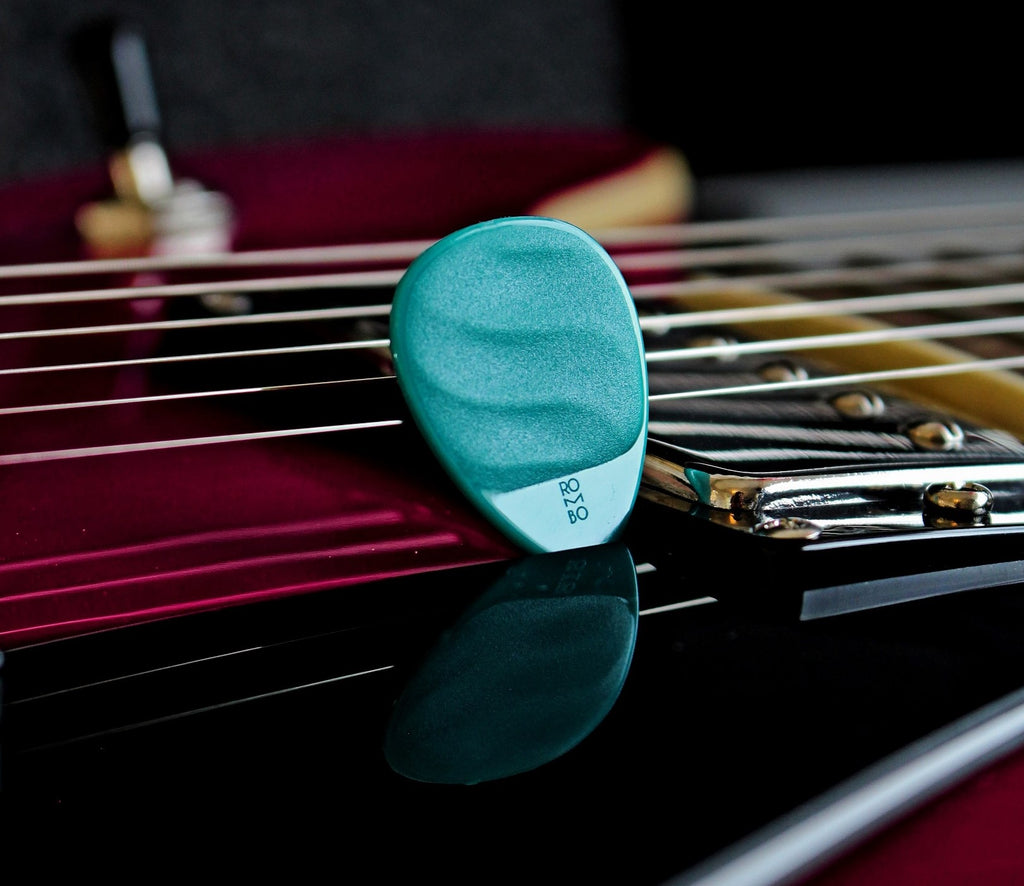
IDEAL GUITAR PICK FOR CLEAR AND DEFINED TONES
Clear and defined guitar tones are produced by pointy pick tips. Ideally, the surface of the tip is polished and has a beveled edge.
Most guitarists prefer small picks for these kinds of tones. Sweep picking, alternate picking, pinch harmonics, and other advanced lead guitar techniques are much easier to perform with such picks.
Depending on your preferences you can then choose different materials: Tortex will increase the attack and create very bright peaks, while Nylon will produce a fuller sound with more bass. Other materials (celluloid, carbon, wood,...) will behave differently.
Rombo Jade is the perfect candidate for speed, control, and attack.

CONCLUSION
Do picks change your guitar tone? Definitely yes!
Not only the tone is affected but other aspects like flexibility, grip, pick noise, attack, or control will be affected by the guitar pick too.
Sound changes will remain as a way of adding some color and dynamic to your music and guitar picks can help you here. With a very low budget and little time, you can experiment and add some fresh input to your daily guitar practice.
The most convenient way of trying many different guitar picks in just one session is by trying a variety pack containing many different guitar picks. Here you can find ours!